Showing posts with label companions. Show all posts

7/11/24

Mr. Barbo: Mount Equinox's Beloved Dog


Thousands visit Mr. Barbo's gravesite every year atop Mount Equinox in beautiful Vermont.


Joseph George Davidson was a chemist and inventor who was partly responsible in the development of mustard gas during WWI and the atomic bomb during WWII - two destructive acts in human history that bore heavily on his conscience. In the 1940s, he began buying tracts of land on Mount Equinox, one of Vermont's tallest mountains. In the 1950s, Davidson, his wife and his beloved dog Mr. Barbo, a Norwegian Elkhound and Siberian Husky mix, moved to the land in their mountain top home. By the time he retired in the 1960s, he owned almost 11 square miles of land.

In November 1955, during the deer hunting season, 12 yo Mr. Barbo was shot and killed by a hunter. Davidson was heartbroken and livid. He banned hunting on his property and hired a sheriff's deputy to enforce it. He also offered a reward for the assailant's identity, who had never been found.

A granite monument stands at Mr. Barbo's gravesite on the mountain with the inscription: "We loved him and he repaid that love with an adoring devotion that only a dog could give. Shot and killed by a malicious hunter Nov. 24, 1955."

Davidson passed away in 1969, and his land was donated to an order of Carthusian monks - the Charterhouse of the Transfiguration is the only Carthusian monastery in the U.S. "No Hunting" signs remain to this day and the monks still keep up Mr. Barbo's grave.


5/14/24

Flush: Elizabeth Barrett Browning's Dog


Elizabeth Barrett Browning, an English poet of the Victorian era, loved dogs and was inspired to write a 20-stanza poem about her beloved cocker spaniel Flush.


Elizabeth had received Flush from a good friend and fellow writer, Miss Mary Russell Mitford. The two bonded quickly, and it didn't take long for her to spoil the adorable cocker spaniel. She would hand feed him cakes, custards and scraps of beef, and because her doctor did not approve of the dog sleeping on the sofa with her, she would bathe him daily so he could.

Flush was stolen from Elizabeth three times. The first theft was in 1843. Because her father refused to pay the full ransom, Elizabeth defied his wishes and secretly arranged for full payment. The third time was less than two weeks before she married Robert Browning, also an English poet. The ransom was paid and Flush was returned five days before the wedding in 1846.

Flush was not happy when Robert first came into Elizabeth's life. He did not like having to share his mistress with him, and despite Robert trying to win his affection with treats, the jealous dog bit him a couple of times. It wasn't until after the wedding that Flush eventually became friends with Robert and the two would go on long walks together.

To Flush, My Dog

Loving friend, the gift of one,
Who, her own true faith, hath run,
Through thy lower nature;
Be my benediction said
With my hand upon thy head,
Gentle fellow-creature!

Like a lady's ringlets brown,
Flow thy silken ears adown
Either side demurely,
Of thy silver-suited breast
Shining out from all the rest
Of thy body purely.

Darkly brown thy body is,
Till the sunshine, striking this,
Alchemize its dulness, -
When the sleek curls manifold
Flash all over into gold,
With a burnished fulness.

Underneath my stroking hand,
Startled eyes of hazel bland
Kindling, growing larger, -
Up thou leapest with a spring,
Full of prank and curvetting,
Leaping like a charger.

Leap! thy broad tail waves a light;
Leap! thy slender feet are bright,
Canopied in fringes.
Leap - those tasselled ears of thine
Flicker strangely, fair and fine,
Down their golden inches.

Yet, my pretty sportive friend,
Little is 't to such an end
That I praise thy rareness!
Other dogs may be thy peers
Haply in these drooping ears,
And this glossy fairness.

But of thee it shall be said,
This dog watched beside a bed
Day and night unweary, -
Watched within a curtained room,
Where no sunbeam brake the gloom
Round the sick and dreary.

Roses, gathered for a vase,
In that chamber died apace,
Beam and breeze resigning -
This dog only, waited on,
Knowing that when light is gone,
Love remains for shining.

Other dogs in thymy dew
Tracked the hares and followed through
Sunny moor or meadow -
This dog only, crept and crept
Next a languid cheek that slept,
Sharing in the shadow.

Other dogs of loyal cheer
Bounded at the whistle clear,
Up the woodside hieing -
This dog only, watched in reach
Of a faintly uttered speech,
Or a louder sighing.

And if one or two quick tears
Dropped upon his glossy ears,
Or a sigh came double, -
Up he sprang in eager haste,
Fawning, fondling, breathing fast,
In a tender trouble.

And this dog was satisfied,
If a pale thin hand would glide,
Down his dewlaps sloping, -
Which he pushed his nose within,
After, - platforming his chin
On the palm left open.

This dog, if a friendly voice
Call him now to blyther choice
Than such chamber-keeping,
'Come out!' praying from the door, -
Presseth backward as before,
Up against me leaping.

Therefore to this dog will I,
Tenderly not scornfully,
Render praise and favour!
With my hand upon his head,
Is my benediction said
Therefore, and for ever.

And because he loves me so,
Better than his kind will do
Often, man or woman,
Give I back more love again
Than dogs often take of men, -
Leaning from my Human.

Blessings on thee, dog of mine,
Pretty collars make thee fine,
Sugared milk make fat thee!
Pleasures wag on in thy tail -
Hands of gentle motion fail
Nevermore, to pat thee!

Downy pillow take thy head,
Silken coverlid bestead,
Sunshine help thy sleeping!
No fly's buzzing wake thee up -
No man break thy purple cup,
Set for drinking deep in.

Whiskered cats arointed flee -
Sturdy stoppers keep from thee
Cologne distillations;
Nuts lie in thy path for stones,
And thy feast-day macaroons
Turn to daily rations!

Mock I thee, in wishing weal? -
Tears are in my eyes to feel
Thou art made so straightly,
Blessing needs must straighten too, -
Little canst thou joy or do,
Thou who lovest greatly.

Yet be blessed to the height
Of all good and all delight
Pervious to thy nature, -
Only loved beyond that line,
With a love that answers thine,
Loving fellow-creature!


Virginia Woolf wrote a biography of Flush which was a best-seller when it was published in 1933, and a canine actor played the role of Flush in the 1934 movie "The Barretts of Wimpole Street".

3/3/24

Dogs in Charles Lindbergh's Life


Charles Lindbergh was born in 1902 and grew up as an ordinary boy on a farm in Minnesota. In 1927, he became the first aviator to complete a nonstop solo transatlantic flight from New York to Paris. He became an international hero and later wrote a Pulitzer Prize-winning book about the experience. In 1932, his 20 month old baby boy, Charles Lindbergh Jr., was kidnapped and killed. Partly because of his popularity, the crime and its aftermath sparked a media frenzy and the first "Trial of the Century." Late in life, he became concerned that modern technology was taking a toll on the world's plants and animals. He became a conservationist, arguing that he would rather have "birds than airplanes." Lindbergh died in 1974 at the age of 72.

Below are photos of some of the dogs in Charles Lindbergh's life:


Charles Lindbergh and his dog Spot 1910


Charles Lindbergh and his dog Dingo 1912


Charles Lindbergh at Lambert Field in St. Louis before proceeding to NY for the New York-Paris flight 1927


Charles Lindbergh Jr. with family dogs Bogey and Skean 1931

11/14/23

Pet Dogs Belonging to the Donner Party


Emigrants in the Donner Party had to resort to desperate measures during a difficult time.


In April 1846, the Donner Party - a group of American pioneers led by George Donner - migrated to California from the Midwest in covered wagons. Behind schedule, they decided to take a shortcut that no other wagon has traveled before. The journey turned out to be extremely difficult and the group became snowbound in several feet of snow in the Sierra Nevada mountains. Much of their supplies and livestock were lost on the trail, and members of the group began to perish from starvation.

About a month after the group became snowbound, some of the strongest members attempted to walk out of the mountains to find help. After a month of walking, seven of the 15 made it to California and helped organize rescue efforts.

While waiting to be rescued, the people stranded in ramshackle tents and cabins on the mountain had to resort to eating their remaining livestock, pet dogs and even human flesh.


Nero, one of the Donner Party pet dogs.

Rescue parties did arrive and helped the survivors back to civilization, but several died while trying to walk out of the mountains. The last survivor to leave the camp was in April 1847. Only 45 of the original 81 members of the Donner Party survived, 32 of them children. George Donner, his brother, both of their wives and four of their children all perished.

4/12/23

Beau: Inspired Jimmy Stewart to Write a Poem


Jimmy Stewart, American film and stage actor, wrote a heartfelt poem about his dog Beau after his beloved pet died.


Jimmy Stewart playing ball with his dogs

Jimmy Stewart loved dogs, and he and his wife Gloria had several throughout their long-time marriage. Stewart was especially fond of his golden retriever Beau, who would sleep in a corner of the bedroom at night, but would sometimes sneak onto the bed and lie between Stewart and Gloria. According to Stewart, "I know that I should have pushed him off the bed, but I didn't. He was up there because he wanted me to pat his head, so that's what I would do. Somehow, my touching his hair made him happier, and just the feeling of him laying against me helped me sleep better."

When Beau became terminally ill and had to be euthanized, Stewart sat in his car, following the procedure, for ten minutes to clear his eyes of tears. He later recalled, "After he died there were a lot of nights when I was certain that I could feel him get into bed beside me and I would reach out and pat his head. The feeling was so real that I wrote a poem about it and about how much it hurt to realize that he wasn't going to be there anymore."

The poem, titled Beau, was first recited on The Tonight Show Starring Johnny Carson in 1981. As you will hear in his poem, Beau (like all his dogs) was not good at things like 'sit', 'stay' and 'come'. Stewart said, "The difference between 'trained OK' and 'trained perfectly' doesn't really matter all that much to me.... I suppose the truth is that I'd rather have a happy dog than a trained one."

The poem starts out with humor and ends with sadness - with both Stewart and Carson trying their best to hold back tears.


1/29/23

Dogs: Norman Rockwell's Pets and Models


Norman Rockwell loved dogs, as pets and as subjects in his artwork.


Norman Rockwell was an American painter and illustrator. Many of his illustrations depicting real-life scenes appeared on the cover of The Saturday Evening Post for almost 50 years. He would use his own dogs and neighbors' dogs as models - a photographer would capture the dog's pose for Rockwell to draw.


"Obtaining good photographs of animals for use in pictures is quite a test of your photography or, in my case, my photographer... The person taking the photographs must be extremely quick and ingenious because an animal may assume the pose you want for only a split second and you must be ready to snap the photograph at that unpredictable moment. I hold the animal where I hope he will assume the desired pose and my photographer focuses on him. Then I try to induce the model to take the desired pose. When he does I yell at the photographer to shoot. Sometimes the result is a blurred picture but other times I am lucky."

Rockwell's own dogs would accompany him to the studio and lay alongside him as he worked. On one occasion, he had to go to Europe and leave his collie Raleigh behind. The dog missed him so much - he lost a lot of weight, his health deteriorated and his whiskers turned white. The veterinarian surely thought he would die. When Rockwell returned, he hand-fed Raleigh every two hours. The dog put on weight and perked up but his whiskers remained white. Rockwell told Raleigh he would never leave him alone again if he would let his whiskers get back to their natural color. After a few weeks, his whiskers were dark again, and Rockwell never left him alone again.


12/23/22

Geoffrey and Stanley: Appear with Hitchcock in The Birds


Alfred Hitchcock is known to have owned at least four Sealyham terriers in his lifetime - Mr. Jenkins, Geoffrey, Stanley and Sarah.


Hitchcock loved and pampered his terriers. According to Hilton Green, assistant director of Psycho, "...those dogs ate better than most people in the world. I mean, he would go to the store and get the finest cut of meat and have them ground it up for these dogs. They were wonderful! He would bring them to work. They would be in his office, and he loved them dearly."

In his film The Birds, Hitchcock did a cameo appearance with Geoffrey and Stanley. He can be seen walking his terriers out of a pet shop as Melanie Daniels (played by Tippi Hedren) enters.


Hitchcock also named his production company for the film Marnie after his two terriers - Geoffrey Stanley Productions.

10/4/22

Eleanor Ritchey's Dogs Inherit Millions


More than 150 dogs, once homeless, inherit over $4 million when their owner dies.


Eleanor Ritchey, the heiress of the Quaker State Refining Corporation, was not fond of people, but she did love dogs. When growing up, she was not allowed to have one. As she got older, she would care for aging family members. She never married or had children. When her mother passed away in 1960, when Eleanor was 50 years old, she started bringing homeless dogs into her life. Hired help would drive her around in her Cadillac as she searched for them. When the number of dogs grew, so did her land. Eventually, she had 150 dogs on 180 acres.

When Eleanor passed away in 1968, all her wealth went to her dogs to ensure the lifetime care of them. When the last dog, Musketeer, died in 1984, the money (which had grown to almost $12 million) went to Auburn University to fund veterinary research.


4/23/22

Charley: John Steinbeck's Traveling Companion


Charley, a "blue" standard poodle, accompanied John Steinbeck on his journey across the United States.


Charles le Chien, a.k.a. Charley, was born on the outskirts of Paris in 1950. The well-groomed poodle who took much pride in his looks, preferred the French language over English and did not like being subjected to baby talk because, according to Steinbeck, "he feels that he is a first-rate dog and has no wish to be a second-rate human."

Feeling like he had lost touch with his own country, Steinbeck decided to travel across the US "in search of America" in a pickup-camper with Charley. Charley loved going on road trips and was apparently worried during the planning and packing that he would be left behind. "During the weeks of preparation he was underfoot the whole time and made a damned nuisance of himself. He took to hiding in the truck, creeping in and trying to make himself look small."

The two left in the fall of 1960, driving from the east to the west to the south and back up to Long Island. The mission of his trip was to interact with the common people, and Charley, his "ambassador", was a great icebreaker when it came to talking to strangers.

Months later, Steinbeck recorded their journey in a book titled Travels with Charley: In Search of America. The book is more focused on the people than Charley, but one passage really brings out the personality of his beloved poodle: "Charley likes to get up early, and he likes me to get up early, too. And why shouldn’t he? Right after his breakfast he goes back to sleep. Over the years he has developed a number of innocent-appearing ways to get me up. He can shake himself and his collar loud enough to wake the dead. If that doesn’t work he gets a sneezing fit. But perhaps his most irritating method is to sit quietly beside the bed and stare into my face with a sweet and forgiving look on his face; I come out of deep sleep with the feeling of being looked at. But I have learned to keep my eyes tight shut. If I even blink he sneezes and stretches, and that night’s sleep is over for me. Often the war of wills goes on for quite a time, I squinching my eyes shut and he forgiving me, but he nearly always wins. He likes traveling so much he wanted to get started early, and early for Charley is the first tempering of darkness with the dawn."

Charley passed away shortly after their trip in 1961. John Steinbeck was awarded the Nobel Prize in Literature in 1962 for his realistic and imaginative writings, and died in 1968 at the age of 66. The pickup-camper (which Steinbeck named Rocinante, after Don Quixote's horse) was restored and is on display at the National Steinbeck Center in Salinas, California.


4/3/22

Como tu: Solves Master's Murder


According to a 19th century German true crime anthology, Como tu helped solve his master's murder.


One Saturday in the 1800s, a butcher in Seville Spain named Juan went hunting with his godfather Marquez for the weekend. When Juan returned home on Monday without Marquez, Marquez's wife became concerned. Juan told her they had separated during the hunt and he should be back soon. That evening, Marquez's dog Como tu, who accompanied the men on the hunt, returned home without his master. The dog appeared agitated and grabbed the wife's dress with his teeth, trying to lead somewhere. She disregarded the dog's behavior and assumed her husband was with some of his hunting friends.

The wife and dog went to Juan's house. When they got there, Como tu, who was normally friendly with Juan, sprang for his throat. Marquez's wife pulled the dog off, and Juan told her Como tu must have rabies and should be shot. She resisted him and decided to go to the police station. The wife told the police her story and how her dog had been behaving. The police even witnessed Como tu's behavior when the quiet dog suddenly became aggressive when he heard Juan's voice at the station. The police commissioner thought Juan might have abused the dog.

Two days later, the wife takes Como tu to the area where her husband had gone hunting, hoping to find him. When she came to a cliff over a river, Como tu grabbed her dress and tried to pull her forward. She pulled back, not wanting to go down the cliff, and returned home. As the two passed Juan's butcher shop, the dog tried again to attack Juan.

Marquez's wife went to the police station and told an officer about the dog's behavior near the cliff. The next morning, the officer went to the cliff and spotted three men at the bottom trying to pull blood-smeared clothing off a body. Juan was one of the men. The other two said Juan offered them money to help him remove the body and throw it in the river. All three were arrested.

Juan admitted to killing Marquez over a fight about a partridge. Both had threatened each other. Juan said he fired at Marquez, only intending to disable him, but his anger and drunkenness drove him to finish the job by hitting him on the head with his shotgun butt.

Because there was no evidence of premeditation and some evidence to support self defense, Juan was sentenced to five years in prison. The two men were sentenced to six months.


8/7/21

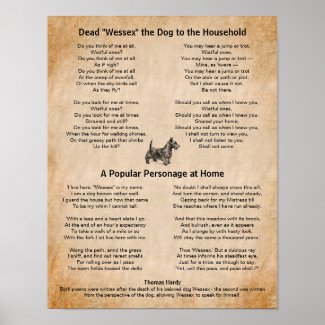
Wessex: Thomas Hardy's Disobedient Dog

Thomas Hardy loved Wessex despite his mischievous ways, and even wrote two famous poems about him.


Wessex, Wessie for short, was bought by Thomas Hardy's second wife to protect their home. The fox terrier, related to King Edward VII's dog Caesar, was not well-liked by Hardy at first due to his unruly behavior. He would nip and shred pant legs of servants and guests, and even bit the leg of novelist John Galsworthy. Overtime, Hardy became very attached to Wessie. He would take him for car rides, let him lie on a comfortable bed in his study, and kiss him every night before bedtime.

Wessie was given a radio as a gift by a company and fell in love with it. He listened to it often, and Hardy would even wake up early in the morning to turn the radio on for him. Once, while at a dress rehearsal, he was at his best behavior, until the time came for his favorite radio program - he howled and caused such a fuss that Hardy had to take him home.

Wessie was put to sleep at the age of 13 in December 1926. In a letter to a friend, he says "We miss him greatly, but he was in such misery with swelling and paralysis that it was a relief when a kind breath of chloroform administered in his sleep by 2 good-natured Doctors (not vets) made his sleep an endless one - A dog of such strong character required human doctors!"

After his death, Hardy wrote two poems about him:

Dead "Wessex" the Dog to the Household

Do you think of me at all,
Wistful ones?
Do you think of me at all
As if nigh?
Do you think of me at all
At the creep of evenfall,
Or when the sky-birds call
As they fly?

Do you look for me at times,
Wistful ones?
Do you look for me at times
Strained and still?
Do you look for me at times,
When the hour for walking chimes,
On that grassy path that climbs
Up the hill?

You may hear a jump or trot,
Wistful ones,
You may hear a jump or trot —
Mine, as 'twere —
You may hear a jump or trot
On the stair or path or plot;
But I shall cause it not,
Be not there.

Should you call as when I knew you,
Wistful ones,
Should you call as when I knew you,
Shared your home;
Should you call as when I knew you,
I shall not turn to view you,
I shall not listen to you,
Shall not come.


A Popular Personage at Home (this poem was written from the perspective of the dog)

'I live here: "Wessex" is my name:
I am a dog known rather well:
I guard the house but how that came
To be my whim I cannot tell.

'With a leap and a heart elate I go
At the end of an hour’s expectancy
To take a walk of a mile or so
With the folk I let live here with me.

'Along the path, amid the grass
I sniff, and find out rarest smells
For rolling over as I pass
The open fields toward the dells.

'No doubt I shall always cross this sill,
And turn the corner, and stand steady,
Gazing back for my Mistress till
She reaches where I have run already,

'And that this meadow with its brook,
And bulrush, even as it appears
As I plunge by with hasty look,
Will stay the same a thousand years.’

Thus 'Wessex.' But a dubious ray
At times informs his steadfast eye,
Just for a trice, as though to say,
'Yet, will this pass, and pass shall I?'


7/8/21

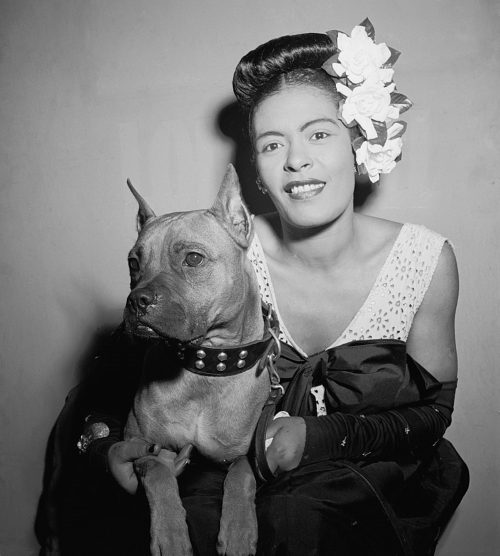
Mister: Billie Holiday's Canine Soul-Mate


Billie Holiday (born Eleanora Fagan and nicknamed Lady Day) loved dogs and had many during her life, including a poodle, a Great Dane, Chihuahuas and a wire-haired terrier, but the one who really captured her heart was a boxer named Mister.


Billie Holiday and her dog Mister

Billie Holiday, considered one of the best jazz vocalists of all time, lived a hard life of childhood poverty, early sexual abuse, racism, difficult relationships with men, depression and addiction before dying at a young age of 44 from heart and liver problems. Despite her troubles, she did find joy in her music and with her dogs, "her only trusted friends."

Mister, Holiday's favorite dog, would accompany her to Harlem's most glamorous clubs where he would eat plates of thick steak and keep fans at a polite distance while she performed. She would knit sweaters for the pampered pooch, cook for him, cloak him in a mink coat and take him on midnight walks.

In May 1947, Holiday was arrested for possession of narcotics and was sentenced to prison in West Virginia, having to leave Mister behind. When she was released in March 1948, the two were reunited. She didn't think Mister would recognize her but, according to her autobiography, when she got off the train to greet him, "He not only recognized me, but in a flash he leaped at me, kicked my hat off, and knocked me flat on my can in the middle of that little station. Then he began lapping me and loving me like crazy." Unfortunately, a woman in the crowd thought the dog was attacking her and screamed for help, causing a crowd to gather, including reporters - messing up her plans to reenter society quietly.

I am not sure when Mister passed away.


3/16/21

Marilyn Monroe and Her Dog Maf


Marilyn Monroe loved dogs and had many throughout her life. Maf was one who outlived her.


Maf, a Maltese terrier, was sometimes described by Marilyn Monroe as a poodle. Some say Pat Newcomb, Marilyn's press agent, gave Maf to her but according to a statement made by Marilyn, her little white snowball was given to her by her dear old friend Frank Sinatra. It is believed that Sinatra bought Maf in 1961 from Natalie Wood's mother (a dog breeder), and Marilyn named the dog Mafia Honey as a humorous reference to Sinatra's alleged mafia connections.

The pampered dog was allowed to sleep on her expensive fur coat, accompanied her to fancy Hollywood restaurants and department stores, and even got to meet President Kennedy. Unfortunately, their time together was short-lived due to Marilyn's premature death in 1962. Maf was given to Gloria Lovell, Sinatra's secretary, and later tragically died when he was run over by a car.


12/22/20

Old Drum: Man's Best Friend


It was the closing argument, A Tribute to the Dog, at Old Drum's trial that coined the phrase "man's best friend".


Monument to Old Drum, Johnson County Courthouse

In October 1869, Old Drum, a black and tan hound dog belonging to Charles Burden, was found dead lying on the banks of Big Creek in Missouri. Burden sued his brother-in-law Leonidas Hornsby (a farmer who believed the hound killed some of his sheep) for damages claiming he was responsible for his dog's death by having his nephew shoot him.

When the case went to trial for the fourth time, Burden was represented by George Graham Vest, a lawyer who was well known for his skills in oration and debate. His closing remarks, with no reference to the evidence or to Old Drum, was a powerful tribute to all dogs and their masters:

Gentlemen of the jury. The best friend a man has in the world may turn against him and become his enemy. His son or daughter whom he has reared with loving care may prove ungrateful. Those who are nearest and dearest to us, those whom we trust with our happiness and our good name, may become traitors to their faith. The money that a man has he may lose. It flies away from him perhaps when he needs it most. A man's reputation may be sacrificed in a moment of ill-considered action. The people who are prone to fall on their knees to do us honor when success is with us may be the first to throw the stone of malice when failure settles its cloud upon our heads. The one absolutely unselfish friend that a man can have in this selfish world, the one that never deserts him, the one that never proves ungrateful or treacherous, is his dog.

Gentlemen of the jury. A man's dog stands by him in prosperity and in poverty, in health and in sickness. He will sleep on the cold ground when the wintry winds blow and the snow drives fiercely, if only he can be near his master's side. He will kiss the hand that has no food to offer, he will lick the wounds and sores that come in encounter with the roughness of the world. He guards the sleep of his pauper master as if he were a prince.

When all other friends desert, he remains. When riches take wings and reputation falls to pieces, he is as constant in his love as the sun in its journey through the heavens. If fortune drives the master forth an outcast into the world, friendless and homeless, the faithful dog asks no higher privilege than that of accompanying him, to guard him against danger, to fight against his enemies. And when the last scene of all comes, and death takes the master in its embrace and his body is laid in the cold ground, no matter if all other friends pursue their way, there by his graveside will the noble dog be found, his head between his paws and his eyes sad but open, in alert watchfulness, faithful and true, even unto death.


The jury quickly returned a verdict in favor of Burden in the amount of $50 plus court costs.

In 2017, the Missouri State Senate officially designated Old Drum as "Missouri's Historical Dog".


11/17/20

Martha: Inspired Paul McCartney


Martha My Dear, a song on the English rock band's only double album The Beatles (aka the White Album), was named after Paul McCartney's beloved sheepdog.


Martha & Paul McCartney

In 1966, Paul McCartney, who grew up without a dog, decided it was time to have one for his new home in London. He chose an Old English sheepdog, named her Martha, and the two quickly developed a strong bond. Paul recalls, "She was a dear pet of mine. I remember John being amazed to see me being so loving to an animal. He said, 'I've never seen you like that before.' I've since thought, you know, he wouldn't have. It's only when you're cuddling around with a dog that you're in that mode, and she was a very cuddly dog."

In 1968, Paul wrote Martha My Dear, and many assumed it was about a woman. However, according to Paul, he made the lyrics general enough so they could be heard as a message to a woman or dog. "It's a communication of some sort of affection, but in a slightly abstract way. 'You silly girl, look what you've
done,' all that sort of stuff. These songs grow. Whereas it would appear to anybody else to be a song to a girl called Martha, it’s actually a dog, and our relationship was platonic, believe me."

Martha, my dear
Though I spend my days in conversation
Please, remember me
Martha, my love
Don't forget me
Martha, my dear

Hold your head up, you silly girl
Look what you've done
When you find yourself in the thick of it
Help yourself to a bit of what is all around you
Silly girl

Take a good look around you
Take a good look you're bound to see
That you and me were meant to be
With each other
Silly girl

Hold your hand out, you silly girl
See what you've done
When you find yourself in the thick of it
Help yourself to a bit of what is all around you
Silly girl

Martha, my dear
You have always been my inspiration
Please, be good to me
Martha, my love
Don't forget me
Martha, my dear


Martha passed away in 1981 at the age of 15.


8/30/20

Dormie: A Rich Man's Dog Tried for Cat Murder


Dormie made history in 1921 when he was tried for the murder of 14 cats in San Francisco, California.


Dormie being paw printed before the trial

Dormie, a full-blooded Airedale, belonged to a wealthy man named Eaton McMillan. He was charged with killing 14 cats, the principal victim being Sunbeam (a Persian-Angora cat owned by Marjorie Ingals), and went on trial before a jury. According to the Los Angeles Herald, 21 December 1921: "It was the first time in the history of jurisprudence that a canine has been brought to trial for a capital crime. This was no matter for the city "pound" department, or the cruelty to animals commission. It was a real trial of a real dog on a real charge of murder." It was also reported that the court was uncertain whether to try him of 14 murders or 126 murders (taking into consideration the nine lives of each cat) and whether a jury of his peers should be dogs. "If a jury trial is agreed upon, only a jury of dogs can legally be employed. For only dogs are the equals of dogs." James Brennan, Dormie's attorney, said most Airedales were of a higher order than most men, so the question of equality was quickly dropped.

During the trial, Brennan had other Airedales, other breeds of dogs and Dormie come into the courtroom so Ingals could identify the culprit. She did identify Dormie, but the identification was set aside since he was the only dog that was escorted into the room by a policeman. The defense argued that Dormie was a friendly dog and was loved by many of the neighborhood kids. A character witness was even brought in, an Airedale named Rowdy - who was the brother of  Laddie Boy, President Harding's dog. Rowdy, who had been a personal bodyguard of a Persian cat for many years (and who mourned for days after the cat's death), was to show the jury that Airedales did not hate cats.

The trial ended with a hung jury. Eleven jurors voted to acquit, while only one wanted Dormie to receive the death penalty. Brennan filed a motion for dismissal. The Judge granted the motion, declaring that the San Francisco ordinance which put Dormie on trial was contrary to the Constitution of the state of California. According to the law at that time, a licensed dog had the right to roam free and unlicensed pets like cats did not. Therefore, if a wandering cat encountered a free-roaming dog, it was the cat's responsibility if harmed.


8/29/20

Strider: Robert Plant's Blue-Eyed Merle Dog


Strider, Robert Plant's collie with blue eyes and a mottled merle coat, was the inspiration to Led Zeppelin's song Bron-Y-Aur Stomp.


Robert Plant and his dog Strider

In 1970, Bron-Y-Aur Stomp - as well as most of the other songs on Led Zeppelin's third album Led Zeppelin III - was written by Robert Plant, the lead singer of the English rock band, guitarist Jimmy Page and bassist/keyboardist John Paul Jones at a small 18th century cottage known as Bron-Yr-Aur (meaning "breast of gold" in Welsh - as in a hillside of gold) in the wilderness of Wales. This folk-rock song is about Robert Plant walking in the countryside with his dog Strider:

Ah caught you smiling at me,
That's the way it should be,
Like a leaf is to a tree, so fine
Ah all the good times we had,
I sang love songs so glad
Always smiling, never sad, so fine

As we walk down the country lanes,
I'll be singing a song, hear me calling your name
Hear the wind within the trees,
Telling mother nature 'bout you and me

Well if the sunshine's so bright,
Or on our way it's darkest night
The road we choose is always right, so fine
Ah can your love be so strong
When so many loves go wrong
Will our love go on and on and on and on and on and on?

As we walk down the country lanes,
I'll be singing a song, Hear me calling your name
Hear the wind within the trees,
Telling mother nature 'bout you and me

My, my la de la come on now it ain't too far,
Tell your friends all around the world,
Ain't no companion like a blue eyed merle
Come on now well let me tell you,
What you're missing, missing, 'round them brick walls

So of one thing I am sure,
It's a friendship so pure,
Angels singing all around My dog is so fine
Yeah, ain't but one thing to do
Spend my nat'ral life with you,
You're the finest dog I knew, so fine
When you're old and your eyes are dim,
There ain't no old shep gonna happen again,
We'll still go walking down country lanes,
I'll sing the same old songs, hear me call your name


When performing live, Robert Plant was known to shout out "Strider!" following the song's final line "Hear me call your name" - you can hear it in the video below.


Bron-Y-Aur Stomp (Live at Earls Court 1975)

8/12/20

Peps: Richard Wagner's Favorite Music Critic


Wilhelm Richard Wagner, a 19th century German composer and animal lover, would take advice from his dog Peps when composing his music, including his famous 1845 opera Tannhäuser.


Minna, Richard Wagner's first wife, holding Peps

Richard Wagner noticed that his dog Peps, a Cavalier King Charles spaniel, had a strong appreciation for music, and would respond differently to melodies depending upon their musical keys. According to Wagner's biographer, Peps constantly sat near his master at the piano and would sometimes howl piteously into his face, suggesting the music did not suit him. If it didn't suit Peps, it didn't suit Wagner. Some critics commented that Peps was the only critic Wagner ever listened to.

When Peps became ill with little life left in him, Wagner scarcely left his dog's side - even putting off important work. After Peps passed away, the composer wrote to his friend Praeger: "He died in my arms on the night of the ninth, passing away without a sound, quietly and peacefully. On the morrow we buried him in the garden beside the house. I cried much, and since then I have felt bitter pain and sorrow for the dear friend of the past thirteen years."


5/30/20

Michelangelo's Pomeranian


It is said that the great Italian sculptor and painter Michelangelo (1475-1564) owned a Pomeranian, and the dog would sit on a satin pillow while he watched him paint the Sistine Chapel, one of the greatest artistic achievements in history.

5/4/20

Dog Comforts Mary, Queen of Scots at Execution


Mary, Queen of Scots had always been fond of little dogs, and even managed to have one by her side at the time of her brutal ending.


When Mary, Queen of Scots was sent to Fotheringhay to await her death, she was allowed to bring some servants and her dogs with her. On the day of her execution (February 8, 1587), she hid one of her small dogs under her long skirts and petticoats. No one noticed the dog until after the beheading. According to Robert Wynkfield, a witness to the execution:

"Then one of the executioners, pulling off her garters, espied her little dog which was crept under her cloths, which could not be gotten forth by force, yet afterwards would not depart from the dead corpse, but came and lay between her head and her shoulders, which being imbrued with her blood was carried away and washed, as all things else were that had any blood was either burned or washed clean, and the executioners sent away with money for their fees."

The little dog - one source says a Skye terrier and another says a small white dog (I believe a Maltese) - never moved when the axe struck her three times, and afterwards refused to leave her side. After being washed, one source says the dog refused to eat and died of a broken heart shortly afterwards, and another says it was given to a French princess and lived the rest of its life in France.