Showing posts with label medical. Show all posts

1/9/24

Jimmy: Demonstrates Early EKG Machine


Jimmy helped demonstrate an early version of an electrocardiogram (ECG or EKG), a machine that measures the electrical activity of the heart.


A demonstration to the Royal Society by Waller's dog Jimmy (1909)

Today's EKG machine has come a long way, thanks to many scientists and inventors. The first machine was invented in 1903. It weighed about 600 pounds and required patients to put their limbs into buckets of salt water.

The first practical EKG machine with surface electrodes was created by Augustus DesirĂ© Waller. He lectured on it in Europe and America, often using his pet bulldog Jimmy in his demonstrations. The Times newspaper reported that the demonstration had caused debate in parliament over whether the Cruelty to Animals Act had been violated. The Secretary of State replied as follows: I understand the dog stood for some time in water to which sodium chloride had been added or in other words a little common salt. If my honourable friend has ever paddled in the sea he will understand the sensation. (Laughter) The dog — a finely developed bulldog — was neither tied nor muzzled. He wore a leather collar ornamented with brass studs. Had the experiment been painful the pain would no doubt have been immediately felt by those nearest the dog. (Laughter)

Today's EKG machines weigh just a few pounds and have played a central role in checking for signs of heart disease.


1/2/21

Esmeralda: A Dog with a Breast Implant


A dog named Esmeralda made history as the first recipient to a silicone breast implant.


Dr. Frank Gerow

Breast augmentation began in the 1890s, and a variety of materials were used such as glass balls, ivory, ox cartilage, sponges and paraffin to enhance the look of the breasts with poor results and dangerous side effects. A safer solution did not come about until the early 1960s when two plastic surgeons from the US, Frank Gerow and Thomas Cronin, created the first silicone implant with the help of Dow Corning. It all started when Gerow handled a bag of blood and noticed that it felt a lot like a woman's breast.

The first test subject for the implant was a dog named Esmeralda. According to Thomas Biggs, a junior resident working with Gerow and Cronin, "I was in charge of the dog. The implant was inserted under the skin and left for a couple of weeks, until she chewed at her stitches and it had to be removed." The surgery was deemed a success and Gerow declared that the implants were harmless. Soon after, in 1962, Timmie Jean Lindsey became the first human to receive the implants.


11/10/19

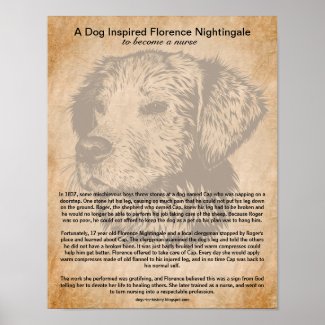
Cap: Florence Nightingale's First Patient


It was Cap, a sheepdog, who inspired Florence Nightingale to become a nurse and make huge changes to the now professional field.


In 1837, some mischievous boys threw stones at Cap who was napping on a doorstep. One stone hit his leg, causing so much pain that he could not put his leg down on the ground. Roger, the shepherd who owned Cap, knew his leg had to be broken and he would no longer be able to perform his job taking care of the sheep. Because Roger was so poor, he could not afford to keep the dog as a pet so his plan was to hang him.

Fortunately, 17 year old Florence Nightingale and a local clergyman stopped by Roger's place and learned about Cap. The clergyman examined the dog's leg and told the others he did not have a broken bone. It was just badly bruised and warm compresses could help him get better. Florence offered to take care of Cap. Every day she would apply warm compresses made of old flannel to his injured leg, and in no time Cap was back to his normal self.

The work she performed was gratifying, and Florence believed this was a sign from God telling her to devote her life to healing others. She later trained as a nurse, and went on to turn nursing into a respectable profession.


10/29/19

Trouve: Alexander Graham Bell's Dog Helps the Deaf Speak


Before his most famous invention, the telephone, Alexander Graham Bell taught his dog Trouve to talk to help benefit the deaf.


Alexander Graham Bell's father was a teacher of the deaf and invented Visible Speech, a writing system to help deaf students learn spoken language. The symbolic notations were based on the shape and movement of the lips and tongue. Bell was intrigued with his father's work and felt it could be used as an aide to teach the deaf to speak. He felt if he could get a deaf person to emit a continuous sound on cue, they could then shape the tone by moving the tongue and lips into words. To test this theory, he used his pet dog, a Skye terrier named Trouve. He figured if he could teach his dog to speak, he could definitely teach a deaf person to speak.

The first thing Bell had to teach Trouve was to growl on cue. He taught him this fairly quickly with the help of treats. Next he had to teach him to sit up on his hind legs and emit a continuous growl so he could easily shape the dog's mouth (using his father's method) to produce sounds. After many treats, Bell taught Trouve to say "Mama" clearly and later "How are you, Grandmama?" which sounded "ow ah oo, ga-ma-ma." Even though, according to Bell, "the dog became quite fond of his articulation lessons," he could not get Trouve to talk just on his own. "I made many attempts, though without success, to cause him to produce the effects without manipulation. He took a bread-and-butter interest in the experiments, but was never able, alone, to do anything but growl."

Although Bell had no experience or prior knowledge of teaching the deaf, he was given the chance to work with children in a small school for deaf children in South Kensington, London.  Eventually, he opened his own school. According to his journal, he was able to teach a deaf student to utter complete and intelligible sentences after a few lessons. His work impressed the wealthy parents of two of his students so much that they helped financially support Bell's other pursuits like the telephone.


5/9/17

Shavka and Brodyaga: The Two-Headed Dog


Sadly, these two dogs became famous in history by becoming one.


Shavka and Brodyaga

In 1959 Vladimir Demikhov, a Soviet scientist and organ transplant pioneer, attached the upper body of a small dog to the neck of a large dog. This was not the first time he performed this procedure (the first was in 1954) but it was the first time the entire transplant procedure was documented, by LIFE magazine.

The small dog was a nine year old female named Shavka and the large male dog who was a stray picked up in the streets by a dog catcher was named Brodyaga (Russian for Tramp).

Both dogs were given an anesthetic prior to the surgery and the areas to be bisected were shaven - the neck of Brodyaga and the midsection of Shavka. Demikhov and his team cut into Brodyaga's neck exposing his jugular vein, aorta and neck vertebrae. Then they cut into Shavka's midsection, layer by layer, attaching small blood vessels to Brodyaga's. After severing Shavka's spine behind her shoulders and removing her lower body they connected the main blood vessels and attached her trachea to his lungs. The final stage was removing Shavka's heart and lungs. Her esophagus was not attached to Brodyaga's stomach, it was placed outside of their bodies.

Both dogs survived the surgery and were able to move independently. Shavka was even able to lap a few mouthfuls of water from a bowl, which the water ran down Shavka's esophagus and down Brodyaga's neck. The nutrients and oxygen Shavka needed to sustain life came from the blood pumped into her system from Brodyaga's heart. Brodyaga was able to walk them both around the yard, and Shavka would even bite the large dog on his ear.

Brodyaga and Shavka died four days after the surgery. One of the neck veins connecting them was strangled, taking both of their lives. These two dogs represent one of twenty such experiments by the Russian surgeon. One pair of dogs lived for 29 days but most lived closer to a week. Tissue rejection (when the recipient's immune system recognizes transplanted tissue as foreign and destroys the tissue) was the cause of death for most of the dogs. Today immunosuppressant drugs are used to limit the risk of tissue rejection.

Demikhov's experiments (mostly on dogs) also included heart, lung, and heart-lung set transplants. His work helped pave the way for human organ transplants, and some believe human head transplants will happen in the near future - for example, transplanting the head of a quadriplegic onto a functional donor body.

Animal testing continues today despite alternative methods. Animal rights groups are working hard to stop animal testing so hopefully one day real soon no more animals will have to suffer to benefit mankind.


11/20/16

Lazarus: Brought Back From the Dead


Five dogs, all named Lazarus, became famous in history as part of an experiment to bring the dead back to life by Dr. Robert E. Cornish in the 1930s - before CPR was developed.


Dr. Robert Cornish holding Lazarus IV & looking at Lazarus V

Robert Cornish (1903-1963) was a child prodigy. At the age of 18 he graduated with honors from Berkeley and four years later he was licensed to practice medicine. Cornish was interested in research and worked on a number of projects, but none sparked his interest so much as his idea to restore life to the dead. By 1933 he had developed an unusual method of reanimation. Cornish attempted his experiment on several dead bodies without success, coming to the conclusion that too long had elapsed since death for it to work, so he decided to perfect his method with freshly euthanized dogs.

In May 1934 Cornish acquired five fox terriers. He named each dog Lazarus after the Biblical figure who was raised from the dead by Jesus (the dogs were dubbed by the press as Lazarus I, II, III, IV and V.) Each dog was killed using a nitrogen gas mixture then strapped to a teeterboard (a seesaw-like contraption) after they were declared clinically dead. The doctor would then inject a solution containing adrenaline into the corpse's thigh, and puff bursts of oxygen into the dog's gaping mouth as an assistant rocked the teeterboard back and forth to slowly draw the solution up and down the body.

The first three dogs are said to have come to life but only briefly before slumping into comas. However, Lazarus IV and V were successfully revived, after their hearts have stopped for five minutes. According to an article in Modern Mechanix (Jan, 1935), Lazarus IV "is blind and cannot stand alone" and "has learned to crawl, bark, sit up on its haunches and consume nearly a pound of meat a day." It also reports "Lazarus V returned nearer normalcy in four days than the other Lazarus in thirteen days." I can find no information on how long the two dogs lived, but it is reported that neither resumed a normal life.

Cornish began his experiments with the dogs at Berkeley but was later asked to leave when the media began reporting his work while experimenting on Lazarus III. Cornish admitted that the dog was more dead than alive, and even debated about using swine instead of dogs, explaining "hogs more nearly resemble humans in their digestive and circulatory systems and have far fewer friends than dogs." But he continued to use the dogs, at his parent's home.

Despite the rather inconclusive outcome, the doctor's experiments with the five fox terriers were hailed as a success. Cornish moved on to other projects, but in 1947 he reemerged with a scheme to "teeter" a freshly deceased human. Thomas McMonigle, a child killer, offered his body for possible reanimation following his execution but the state of California refused Cornish and McMonigle's petition due to concerns a reanimated murderer would have to be freed under the "double jeopardy" clause.


11/10/16

Dogs Help Discover Insulin


Dogs were operated on and lost their lives prematurely to greatly improve the lives of those with diabetes.


Charles Best, Frederick Banting and Marjorie

People with type 1 diabetes produce little or no insulin, a pancreatic hormone needed to allow sugar (glucose) to enter cells to produce energy. Before the discovery of insulin therapy, the only effective treatment for the disease was a strict low-calorie, no-carbohydrate diet that led to slow starvation. In 1921, researchers at the University of Toronto began a series of experiments that would ultimately lead to the isolation and commercial production of insulin.

Ten dogs were used in these experiments. Some were used to extract insulin and others were used to become diabetic by removing the pancreas. The extract was injected into the diabetic dogs which caused their blood glucose levels to drop (a good thing). As the experiments proceeded, the researchers realized that they required a larger supply of organs than their dogs could provide so they started using pancreases from cattle. With this new source, they managed to produce enough extract to keep several dogs alive. Marjorie lived the longest, about 70 days (some believed she died of infection caused by her pancreatectomy.) In January 1922, after research allowed the insulin to be purified to be clean enough for testing on humans, a 14 year old boy was chosen as the first person with diabetes to receive insulin. The boy who was near death rapidly regained his strength and appetite. Other volunteer diabetics reacted just as positively as the boy to the insulin extract.

In 1923, Dr. Frederick Banting (the lead researcher) was awarded the Nobel Prize in Physiology or Medicine. It is reported that Banting loved dogs and it pained him deeply that his pre-human insulin trials were conducted on unsuspecting canines. Despite the long hours and no salary, Banting and his colleague Charles Best took very good care of the dogs. According to Dr. S.M. Sadikot, Consultant in Diabetes, Endocrinology and Metabolic Disorder, Jaslok Hospital and Research Center, Mumbai, "During this period, the dogs were more than experimental animals. They became friends, the dogs seemed to understand the importance of the experiment and were certainly, according to the history, most co-operative with the experiments."