Showing posts with label poets. Show all posts

5/14/24

Flush: Elizabeth Barrett Browning's Dog


Elizabeth Barrett Browning, an English poet of the Victorian era, loved dogs and was inspired to write a 20-stanza poem about her beloved cocker spaniel Flush.


Elizabeth had received Flush from a good friend and fellow writer, Miss Mary Russell Mitford. The two bonded quickly, and it didn't take long for her to spoil the adorable cocker spaniel. She would hand feed him cakes, custards and scraps of beef, and because her doctor did not approve of the dog sleeping on the sofa with her, she would bathe him daily so he could.

Flush was stolen from Elizabeth three times. The first theft was in 1843. Because her father refused to pay the full ransom, Elizabeth defied his wishes and secretly arranged for full payment. The third time was less than two weeks before she married Robert Browning, also an English poet. The ransom was paid and Flush was returned five days before the wedding in 1846.

Flush was not happy when Robert first came into Elizabeth's life. He did not like having to share his mistress with him, and despite Robert trying to win his affection with treats, the jealous dog bit him a couple of times. It wasn't until after the wedding that Flush eventually became friends with Robert and the two would go on long walks together.

To Flush, My Dog

Loving friend, the gift of one,
Who, her own true faith, hath run,
Through thy lower nature;
Be my benediction said
With my hand upon thy head,
Gentle fellow-creature!

Like a lady's ringlets brown,
Flow thy silken ears adown
Either side demurely,
Of thy silver-suited breast
Shining out from all the rest
Of thy body purely.

Darkly brown thy body is,
Till the sunshine, striking this,
Alchemize its dulness, -
When the sleek curls manifold
Flash all over into gold,
With a burnished fulness.

Underneath my stroking hand,
Startled eyes of hazel bland
Kindling, growing larger, -
Up thou leapest with a spring,
Full of prank and curvetting,
Leaping like a charger.

Leap! thy broad tail waves a light;
Leap! thy slender feet are bright,
Canopied in fringes.
Leap - those tasselled ears of thine
Flicker strangely, fair and fine,
Down their golden inches.

Yet, my pretty sportive friend,
Little is 't to such an end
That I praise thy rareness!
Other dogs may be thy peers
Haply in these drooping ears,
And this glossy fairness.

But of thee it shall be said,
This dog watched beside a bed
Day and night unweary, -
Watched within a curtained room,
Where no sunbeam brake the gloom
Round the sick and dreary.

Roses, gathered for a vase,
In that chamber died apace,
Beam and breeze resigning -
This dog only, waited on,
Knowing that when light is gone,
Love remains for shining.

Other dogs in thymy dew
Tracked the hares and followed through
Sunny moor or meadow -
This dog only, crept and crept
Next a languid cheek that slept,
Sharing in the shadow.

Other dogs of loyal cheer
Bounded at the whistle clear,
Up the woodside hieing -
This dog only, watched in reach
Of a faintly uttered speech,
Or a louder sighing.

And if one or two quick tears
Dropped upon his glossy ears,
Or a sigh came double, -
Up he sprang in eager haste,
Fawning, fondling, breathing fast,
In a tender trouble.

And this dog was satisfied,
If a pale thin hand would glide,
Down his dewlaps sloping, -
Which he pushed his nose within,
After, - platforming his chin
On the palm left open.

This dog, if a friendly voice
Call him now to blyther choice
Than such chamber-keeping,
'Come out!' praying from the door, -
Presseth backward as before,
Up against me leaping.

Therefore to this dog will I,
Tenderly not scornfully,
Render praise and favour!
With my hand upon his head,
Is my benediction said
Therefore, and for ever.

And because he loves me so,
Better than his kind will do
Often, man or woman,
Give I back more love again
Than dogs often take of men, -
Leaning from my Human.

Blessings on thee, dog of mine,
Pretty collars make thee fine,
Sugared milk make fat thee!
Pleasures wag on in thy tail -
Hands of gentle motion fail
Nevermore, to pat thee!

Downy pillow take thy head,
Silken coverlid bestead,
Sunshine help thy sleeping!
No fly's buzzing wake thee up -
No man break thy purple cup,
Set for drinking deep in.

Whiskered cats arointed flee -
Sturdy stoppers keep from thee
Cologne distillations;
Nuts lie in thy path for stones,
And thy feast-day macaroons
Turn to daily rations!

Mock I thee, in wishing weal? -
Tears are in my eyes to feel
Thou art made so straightly,
Blessing needs must straighten too, -
Little canst thou joy or do,
Thou who lovest greatly.

Yet be blessed to the height
Of all good and all delight
Pervious to thy nature, -
Only loved beyond that line,
With a love that answers thine,
Loving fellow-creature!
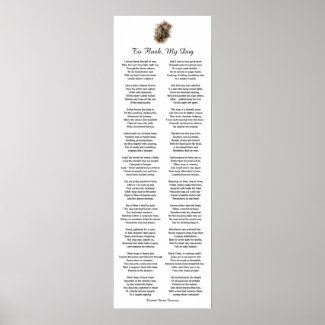


Virginia Woolf wrote a biography of Flush which was a best-seller when it was published in 1933, and a canine actor played the role of Flush in the 1934 movie "The Barretts of Wimpole Street".

3/4/22

Rudyard Kipling: The Power of the Dog Poem


Rudyard Kipling, an English writer (best known for The Jungle Book) and poet, was an avid dog lover. His poem The Power of the Dog addresses how a dog's love, loyalty and devotion brings so much joy in one's life, but also brings so much sorrow when their life comes to an end.


The Power of the Dog

There is sorrow enough in the natural way
From men and women to fill our day;
And when we are certain of sorrow in store,
Why do we always arrange for more?
Brothers and Sisters, I bid you beware
Of giving your heart to a dog to tear.

Buy a pup and your money will buy
Love unflinching that cannot lie—
Perfect passion and worship fed
By a kick in the ribs or a pat on the head.
Nevertheless it is hardly fair
To risk your heart for a dog to tear.

When the fourteen years which Nature permits
Are closing in asthma, or tumour, or fits,
And the vet’s unspoken prescription runs
To lethal chambers or loaded guns,
Then you will find—it’s your own affair—
But… you’ve given your heart to a dog to tear.

When the body that lived at your single will,
With its whimper of welcome, is stilled (how still!).
When the spirit that answered your every mood
Is gone—wherever it goes—for good,
You will discover how much you care,
And will give your heart to a dog to tear.

We’ve sorrow enough in the natural way,
When it comes to burying Christian clay.
Our loves are not given, but only lent,
At compound interest of cent per cent.
Though it is not always the case, I believe,
That the longer we’ve kept ’em, the more do we grieve:
For, when debts are payable, right or wrong,
A short-time loan is as bad as a long—
So why in—Heaven (before we are there)
Should we give our hearts to a dog to tear?


8/7/21

Wessex: Thomas Hardy's Disobedient Dog

Thomas Hardy loved Wessex despite his mischievous ways, and even wrote two famous poems about him.


Wessex, Wessie for short, was bought by Thomas Hardy's second wife to protect their home. The fox terrier, related to King Edward VII's dog Caesar, was not well-liked by Hardy at first due to his unruly behavior. He would nip and shred pant legs of servants and guests, and even bit the leg of novelist John Galsworthy. Overtime, Hardy became very attached to Wessie. He would take him for car rides, let him lie on a comfortable bed in his study, and kiss him every night before bedtime.

Wessie was given a radio as a gift by a company and fell in love with it. He listened to it often, and Hardy would even wake up early in the morning to turn the radio on for him. Once, while at a dress rehearsal, he was at his best behavior, until the time came for his favorite radio program - he howled and caused such a fuss that Hardy had to take him home.

Wessie was put to sleep at the age of 13 in December 1926. In a letter to a friend, he says "We miss him greatly, but he was in such misery with swelling and paralysis that it was a relief when a kind breath of chloroform administered in his sleep by 2 good-natured Doctors (not vets) made his sleep an endless one - A dog of such strong character required human doctors!"

After his death, Hardy wrote two poems about him:

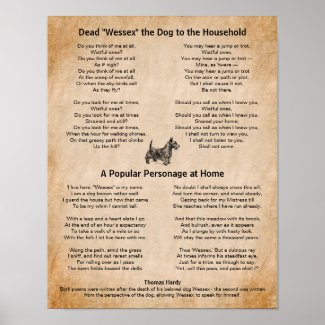
Dead "Wessex" the Dog to the Household

Do you think of me at all,
Wistful ones?
Do you think of me at all
As if nigh?
Do you think of me at all
At the creep of evenfall,
Or when the sky-birds call
As they fly?

Do you look for me at times,
Wistful ones?
Do you look for me at times
Strained and still?
Do you look for me at times,
When the hour for walking chimes,
On that grassy path that climbs
Up the hill?

You may hear a jump or trot,
Wistful ones,
You may hear a jump or trot —
Mine, as 'twere —
You may hear a jump or trot
On the stair or path or plot;
But I shall cause it not,
Be not there.

Should you call as when I knew you,
Wistful ones,
Should you call as when I knew you,
Shared your home;
Should you call as when I knew you,
I shall not turn to view you,
I shall not listen to you,
Shall not come.


A Popular Personage at Home (this poem was written from the perspective of the dog)

'I live here: "Wessex" is my name:
I am a dog known rather well:
I guard the house but how that came
To be my whim I cannot tell.

'With a leap and a heart elate I go
At the end of an hour’s expectancy
To take a walk of a mile or so
With the folk I let live here with me.

'Along the path, amid the grass
I sniff, and find out rarest smells
For rolling over as I pass
The open fields toward the dells.

'No doubt I shall always cross this sill,
And turn the corner, and stand steady,
Gazing back for my Mistress till
She reaches where I have run already,

'And that this meadow with its brook,
And bulrush, even as it appears
As I plunge by with hasty look,
Will stay the same a thousand years.’

Thus 'Wessex.' But a dubious ray
At times informs his steadfast eye,
Just for a trice, as though to say,
'Yet, will this pass, and pass shall I?'


8/21/19

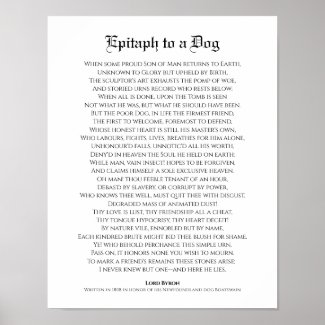
Lord Byron's Famous Epitaph to His Beloved Dog Boatswain


The 19th century romantic poet Lord Byron had a great love of animals, especially for his Newfoundland dog named Boatswain. After the dog's passing, Byron created one of his most famous poems Epitaph to a Dog.


Lord Byron, famous for his poetry and infamous for his lifestyle, truly loved animals. In addition to all the dogs, cats and horses he had during his lifetime, Byron owned a bear, monkeys, a fox, a badger, a goat and many types of birds including an eagle, falcon, peacocks and an Egyptian crane. When he was not allowed to have his pet dog Boatswain live with him at Cambridge University, he bought his bear to live with him instead since there was no mention of bears in the statutes.

Boatswain, only five years old, contracted rabies. Despite the chances of being bit and infected with the deadly disease, Lord Byron nursed his dog until he passed in 1808. Although deep in debt at the time, Byron honored his dog with an impressive marble monument and poem:

When some proud Son of Man returns to Earth,
Unknown to Glory but upheld by Birth,
The sculptor's art exhausts the pomp of woe,
And storied urns record who rests below:
When all is done, upon the Tomb is seen
Not what he was, but what he should have been.
But the poor Dog, in life the firmest friend,
The first to welcome, foremost to defend,
Whose honest heart is still his Master's own,
Who labours, fights, lives, breathes for him alone,
Unhonour'd falls, unnotic'd all his worth,
Deny'd in heaven the Soul he held on earth:
While man, vain insect! hopes to be forgiven,
And claims himself a sole exclusive heaven.
Oh man! thou feeble tenant of an hour,
Debas'd by slavery, or corrupt by power,
Who knows thee well, must quit thee with disgust,
Degraded mass of animated dust!
Thy love is lust, thy friendship all a cheat,
Thy tongue hypocrisy, thy heart deceit!
By nature vile, ennobled but by name,
Each kindred brute might bid thee blush for shame.
Ye! who behold perchance this simple urn,
Pass on, it honors none you wish to mourn.
To mark a friend's remains these stones arise;
I never knew but one—and here he lies.