Showing posts with label WWII. Show all posts

1/15/24

Photograph of Kamikaze Pilots and Puppy


About 3,800 Japanese pilots died in kamikaze attacks during WWII.


Kamikaze pilots petting a puppy the day before their final mission.

Most kamikaze pilots were 17-24 years old. While some were volunteers, others felt pressure to sacrifice their lives for their country.

7/28/23

Dogs in the Holocaust


Tammy Bar-Joseph researched the role of dogs in the Holocaust - both as they were used against Jews and in cases where they saved Jewish lives. Here are three accounts of  Nazi dogs saving Jews:


Nazi dogs were trained to attack, torment and even kill prisoners.

A Great Dane at the Skarzysko-Kamienna labor camp in Nazi-occupied Poland saved Nina Dinar, a teenager at the time. She loved dogs and grew up raising them, so when she saw the Great Dane with a Nazi officer, she called the dog over. To everyone's surprise, the dog walked over to her and licked her. The two developed a special bond over the next few months.

In 1944, when the Russians were approaching, the Germans decided to evacuate the camp and kill those who were weak, including Nina. When she was being taken to her death, the Great Dane stood by her side and succeeded "to persuade" the officer to spare her life.

Nina was sent to another camp before being freed. She started a family and returned to raising dogs. When interviewed by Bar-Joseph in 2019, Nina said, "I never feared dogs; they sense it when someone loves them."


Amon Goeth was executed by hanging in 1946 for "personally killing, maiming and torturing a substantial, albeit unidentified number of people."

When Amon Goeth, the camp commander of the Plaszow concentration camp in German-occupied Poland, sicced his dog on Roman Schwartz for stealing potato peels, Roman ordered the dog to halt and sit. The dog obeyed and Goeth was so impressed that he spared his life.


Dr. Joseph Mengele, the "Angel of Death" who performed deadly experiments on prisoners, selected victims to be killed in the gas chambers, and one of the doctors who administered the gas.

Otto, A young Jewish boy in Auschwitz, was saved by a dog he had befriended.

Dr. Joseph Mengele had Otto trained to become an attack dog. According to Otto, "With whip in hand they trained me to run on all fours, to attack people, to bite, to bark without stopping... They beat me terribly… starved me. And afterward they sicced me on people."

Later, Otto was sent to a sheep farm to replace a herding dog that had died and was to work alongside a real dog named Willy. First, a German officer sicced the dog on him. "He attacked me from behind, tore a piece of flesh from me... But I was strong, I hit him on the head." They spent the night together in the kennel. "After that, we became friends. The dog licked and warmed me in the night."

In 1944, Otto was placed on a transport meant to take him to his death. "Then Willy saved me. He started to look for me everywhere, he ran alongside the cars and barked loudly. Then I also started to bark terribly, and he heard me, jumped into the car, pulled me out of the pile."

Afterwards, Otto reached France, went to an orphanage, and continued behaving like a dog, sometimes attacking other children. His life beyond this is unknown.


3/6/22

Garbo: WWII Submarine Mascot


It wasn't uncommon for submarines during WWII to have dog mascots to help boost morale to the men aboard. Garbo was one of them.


Garbo, USS Gar mascot

The mixed breed puppy boarded the USS Gar (SS-206) in Hawaii between the sub's patrols. The crew took an immediate liking to her, named her Garbo and made her their mascot. Garbo learned her way around the sub, earned the respect of the men, made her home in the forward torpedo room, and would bark on the bullnose whenever the sub got under way. According to Motor Machinist Mate Second Class Jim Bunn, "She owned the boat and knew it."

Garbo was given a collar with the submarine's insignia, and a star was added with each successful patrol. Because of her playful manner, even under the heaviest depth charge attacks, Bunn said, "She should have gotten a medal for keeping our spirits and morale up when we needed it most." Between patrols, Garbo would drink beer with her shipmates - sometimes a little too much.

One night, while the sub was running on the surface during a war patrol in the Palau Islands, the Commanding Officer began an overboard search when their mascot vanished into the darkness after stepping off the cigarette deck. The sub circled enemy waters until someone finally spotted Garbo below the bridge, safe on the main deck.


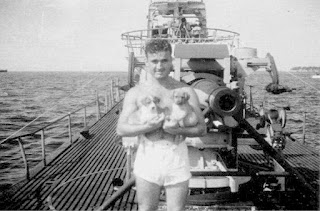
Jim Ellis holding Garbo's pups

While en route to Ulithi, Garbo gave birth to two puppies - the father was the mascot to the USS Tambor (SS-198). The puppies were later traded to other submarines for cases of beer. Garbo stayed with the sub for the rest of its war patrols, then returned to the States to live with Chief Motor Machinist Mate Jim Ellis.

7/13/21

Jackie: Enraged the Nazis During WWII


Jackie, a part Dalmatian dog, made history in the early 1940s, shortly before the invasion of the Soviet Union, for causing a political incident between his owner, his owner's company and Nazi Germany.


Tor Borg, a Finnish businessman, and his dog Jackie

Documents about the incident were discovered some 60 years after it happened. According to the documents, an anonymous source notified Nazi authorities of Tor Borg and his dog Jackie who would raise a single paw whenever he heard the name "Hitler" - imitating the Nazi salute.

Borg was interrogated by the Germans. He admitted that Jackie occasionally did this when his wife, a known anti-Nazi German, called him "Hitler" (a nickname she'd given him because of the way he raised his paw) but insisted that neither his family nor his dog
had done anything "that could be seen as an insult against the German Reich". For three months, the Foreign Office investigated ways to bring Borg to trial, but no witnesses would come forward to allow charges to be pressed against him. Attempts were also made to economically sabotage his business - which is now a leading wholesale pharmaceutical company in Scandinavia. It is unclear whether Hitler had ever been aware or involved in the incident.

According to Klaus Hillenbrand (historian and journalist) on the absurdity of the Nazi effort regarding Jackie, "The dog affair tells us the Nazis were not only criminals and mass murderers, they were silly as hell. There are very few things you can laugh about because what they did was so monstrous. But there were two or three dozen people discussing the affair of the dog rather than preparing for the invasion of the Soviet Union. They were crazy."

Jackie died of natural causes and Borg died at the age of 60 in 1959.


8/8/17

Seven Honored Dogs Who Saved Lives From the Blitz Bombings


Seven dogs became famous in history as heroes for having saved many lives from ruined buildings during the German bombing campaign on British cities during WWII.


When the Germans failed to cripple Britain's air power in anticipation of a land invasion, Hitler decided to create sheer terror as his weapon of choice in hopes that the government would surrender. On September 7, 1940 the Luftwaffe (the Nazi German Air Force) began a bombing campaign against London and other British cities. The bombings, which occurred mostly at night, became known as the blitz - an abbreviation of the German word blitzkrieg meaning lightning war. The attacks continued for eight months, ending May 11, 1941. When over, more than one million people were homeless and tens of thousands were injured and killed (including many civilians), but the Luftwaffe failed at what they were hoping for. More would have died if it weren't for the following dogs:


Irma

Irma was initially a messenger dog in the war but was later retrained to become a search and rescue dog. She had a remarkable ability of finding victims buried under difficult places and even had a special bark to let her handler know if the buried person was alive or dead. On one occasion, Irma signaled with an alive bark and rescuers dug out a man who was apparently dead, but the man eventually stirred proving Irma was right. Irma and a young dog named Psyche who was being trained helped locate 233 people, 21 of whom were found alive.


Beauty

Not all victims from the blitz attacks were people, many were beloved pets. Beauty belonged to Bill Barnett, a PDSA (People's Dispensary for Sick Animals - UK veterinary charity) superintendent who led a rescue squad for animals. Barnett would take Beauty with him on rescue missions to keep him company, but the dog soon wanted to join in on the search. She started to dig in the rubble and within minutes Beauty found a cat, her first of 63 animals she went on to save.


Jet

Jet was initially trained in anti-sabotage work and was later trained in search and rescue duties. He helped save over 100 people from ruined buildings. Historian Ian Kikuchi, who works at Imperial War Museum London said "Even when searching piles of the remains of factories full of dangerous chemical and poisonous smoke, Jet's incredible sense of smell was still able to detect survivors." He was not afraid to enter burning buildings, and once found an elderly woman in a building that was already considered thoroughly searched.


Rip

Rip was a stray dog after his home was bombed and was adopted by the Air Raid Warden. He was made the unit's mascot but began sniffing out casualties when taken to the bombing sites, a job he enjoyed doing. Like Beauty, he was never trained for search and rescue work but took to it instinctively. He was credited for rescuing more than 100 victims.


Peter

Before Peter was offered to the government for war service, he was always getting into trouble such as fighting with other dogs and chewing anything he could get hold of. He was trained as a rescue dog and proved to be a good one. He was credited for finding many bodies and saving six lives, including the life of a small boy. It is said Peter's speed in finding victims saved the men many hours of useless digging.


Rex and Thorn

Rex, trained as a rescue dog, saved 65 people by physically dragging them out of the rubble and leading rescuers to those he couldn't. It is said his uncanny intelligence and outstanding determination helped him find victims in burning buildings despite the intense heat, thick smoke and smouldering debris.

Thorn, who came from a distinguished line of search and rescue dogs, was fearless when finding casualties in unstable situations. Rescuers were baffled in how well he could pick up a scent, including the time he found a family trapped under a burning house, having saved all of their lives.

All seven dogs were awarded the Dickin Medal, the animal equivalent of the Victoria Cross, in 1945 for the outstanding work they did during the German blitzkrieg attacks.


4/6/17

Just Nuisance: Simon's Town Mascot


Just Nuisance became famous in history as the beloved mascot to the sailors in Simon's Town during WWII.


Just Nuisance was born on April Fool's day 1937 in Cape Town, South Africa. The Great Dane who grew to stand 6 feet 6 inches tall on his hind legs was sold to Benjamin Chaney. After buying the pup, Chaney relocated to the naval base in Simon's Town to run the United Services Institute where Royal Navy ships often docked.

When old enough to get around on his own, the gangly dog was allowed to roam freely. He quickly became friends with the sailors and would follow them around, including aboard their ships. He loved lying on the ship's deck, especially at the top of the gangplank making it difficult for the men to come on and off the ship. Because of this, the sailors affectionately began calling him Nuisance.


When the sailors were on leave, they would often take the train to Cape Town which was 22 miles away with many stations in between. Wanting to join in on the fun, Nuisance would hop aboard the train and the men would try their best to hide the big dog. When discovered, the conductor would force Nuisance off at the next stop but the determined dog would catch another train to meet up with his friends. Eventually, despite people willing to pay the dog's fare, Chaney was warned that if his dog did not stop boarding the train he would be put down. This upset many, including the sailors and local townspeople.

To solve the problem, Nuisance was officially enlisted in the Royal Navy on August 25, 1939, entitling him to ride on the trains for free. He underwent the required medical examination and even signed the enlistment papers with a paw print. Nuisance was given as his last name and Just as his first. His trade was listed as Bonecrusher and his religious affiliation as Scrounger which was later changed to Canine Divinity League (anti-vivisection) - one who opposes the practice of performing operations on live animals for the purpose of experimentation or scientific research.


Just Nuisance had his own bed on base but would sometimes sleep on a ship's bunk. On one occasion, a sailor had to sleep on the floor because the dog refused to leave the bed.


Just Nuisance, who was promoted to Able Seaman, never went to sea. His duties were ashore, watching over the sailors, boosting morale and helping to raise money for the war effort. He would attend promotional events, including parades and his own wedding to another Great Dane named Adinda. Just Nuisance soon became the proud father of five puppies, two of which were auctioned off in Cape Town by the Mayor for war funds.

Just Nuisance was good at watching over the men. He would break up bar fights and even escort drunken sailors back to the base. However, he had his own share of misdeeds such as boarding a train without his free pass, refusing to leave bars at closing time, going AWOL (absence without leave), losing his collar, and sleeping on a bed belonging to a Petty Officer.

Due to health problems caused by a car accident, Just Nuisance was discharged from the Navy in January 1944. His condition worsened and on April 1, his 7th birthday, he was put to sleep. The following day, his body was covered with a Royal Naval flag and buried with full military honors at Klaver Camp on top of Red Hill.

Just Nuisance became quite a celebrity in life. Tourists from around the world visit his gravesite, his statue on Jubilee Square, and the town's museum that has a special section honoring the Great Dane.


3/23/17

Chips: Decorated War Hero


Chips became famous in history as the most decorated dog hero of WWII but his medals were later taken away because he was considered equipment and not a soldier who risked his life to save fellow soldiers.


During World War II, shortly after the attack on Pearl Harbor, thousands of patriotic pet owners across America donated their dogs to the K-9 Corps for the war effort. Chips, a German shepherd mix, was one of the first dogs to be shipped overseas.

Chips, three years old at the time, was donated by the Wren family of Pleasantville, NY and was sent to Front Royal, Virginia for training as a sentry dog in 1942. Spirited and quick to learn, Chips served bravely with General Patton's Seventh Army in Africa, Italy and other parts of Europe.

In the invasion landing at Casablanca, Chips and his handler Private John Rowell were among the first to go ashore while bombers attacked from above. Rowell quickly dug a foxhole for him and his dog - the holes were barely deep enough to protect them from the fragments that whizzed over them. When the planes left, Rowell leaped up and began deepening his hole to make it safer before the planes returned. Chips soon caught on to the idea and began scooping his own foxhole deeper.

In the fighting that followed, Chips marched with the battalion by day and stood guard at night. In January 1943, Chips was one of four dogs who patrolled the wired encampment where President Franklin D. Roosevelt and British Prime Minister Winston Churchill stayed while attending the historic Casablanca Conference.

In July 1943, Chips and his battalion landed on the shore of southern Sicily near Licata in Operation Husky. As the platoon worked its way inland they came under fire from a disguised pillbox (a dug-in guard post). The soldiers immediately hit the ground. Chips broke free from Rowell and launched himself right into the pillbox. Rowell later said, "Then there was an awful lot of noise and the firing stopped." The men heard someone inside the nest fire a pistol. Rowell said he then "saw one Italian soldier come out with Chips at his throat. I called him off before he could kill the man. Three others followed, holding their hands above their heads." Chips sustained minor injuries including a wound and powder burns from the bullet that grazed his scalp. Chips was treated, returned to duty that night and helped capture ten more Italians.

Within days the story of Chips' heroism swept through the division and the brave dog was awarded the Silver Star for valor and the Purple Heart for his wounds. The platoon's commander, Major General Lucian K. Truscott, put in a recommendation that Chips receive the Distinguished Service Cross for “courageous action in single-handedly eliminating a dangerous machine gun nest and causing surrender of its crew.” War Department regulations prohibited the awarding of decoration to animals, who were considered military equipment, but the commander's attitude was "regulations be damned". He waived them and on November 19 in Italy Truscott personally awarded Chips the Distinguished Service Cross.

In July 1944, newspapers published stories about Chips' heroism and the medals he received. The War Department got word of this and conducted an investigation. Three months later, Chips' medals were taken away. To honor Chips, his unit (the 3rd Infantry Division) unofficially awarded the brave dog a theater ribbon with an arrowhead for an assault landing, and battle stars for each of his eight campaigns.


Chips greeted by his owners upon his return to the US - Dec 1945

In the fall of 1945, Chips was given an honorable discharge and was taken back to Front Royal where he was retrained so he could return to the Wren family. When Mrs. Wren was asked about Chips' medals, she said she thought dogs ought to have medals, but she had a feeling Chips himself would have preferred a pound of hamburger.

Chips died a few months later at the age of six and was buried at the Hartsdale Canine Cemetery. In 1990, Disney made a TV movie based on his life entitled Chips, the War Dog.


3/12/17

Two Bits: Survived Falling 600 Feet - Twice!


Two Bits became famous in history as a war hero on the home front in the US during WWII for not giving up his fun of chasing chipmunks despite his two falls over a cliff while doing so.


Two Bits inside the lookout building

During the winter of 1942-1943, Bill Ziegler with his dog Two Bits and another man worked for the Army Air Corps in the remote wilderness of Rogue River National Forest in Oregon. A 14 by 14 foot lookout facility sat on top of Whiskey Peak, 6,497 feet above ground, next to a near-vertical 600 foot drop to the valley below. The facility was a US Forest Service fire spotting point that the army took over during WWII as part of its Aircraft Warning Service. The two men were to observe the western skies for enemy aircraft until the new technology of radar could be installed in strategic places.


Whiskey Peak

Two Bits was a fox terrier who loved to chase the chipmunks that hung around begging for food. By February, the snow on the summit was abundant and ice had formed over the nearby cliff. One day Two Bits went running after the rodents with too much enthusiasm near the edge of the cliff. He skidded across the ice and fell over the ledge. Ziegler, who was a good distance away, saw his poor dog go over. The distraught man walked to the point where Two Bits fell, looked at the 600 foot drop and knew there was no way his beloved dog could have survived the plunge.

About a week later, Ziegler was on a nearby trail when he was amazed to see Two Bits climbing slowly up toward him with his head down and his tongue hanging out. The dog was tired but still managed to happily wag his tail. Apparently Two Bits had fallen into a deep snowdrift that cushioned his fall, was able to dig himself out and make the long trek back to his owner. After he got some food in his belly and much needed rest, the spunky dog went back to his normal routine.

You would think Two Bits learned his lesson, but a few weeks later he took the same plunge. Again, Zeigler assumed the worst, but to his amazement the determined dog made it back to the top of Whiskey Peak a few days later.

Once his duty was over, Zeigler and Two Bits returned to their Jacksonville home. The news of the dog surviving two falls over the cliff "without physical impairment or loss of morale" went national. The Medford Mail Tribune and even Life magazine hailed Two Bits as a war hero and canine symbol of Home Front "stolidity and determination."

Two Bits lived a good life and passed away a few years after the war ended.


3/11/17

Dzhulbars: Soviet Sniffer Dog


Dzhulbars, a Soviet war dog, became famous in history for detecting thousands of explosives during World War II.


Soviet mine detection dogs (also referred to as sniffer dogs) combed more than 9,000 square miles of land and discovered more than four million enemy charges and land mines during and after the Second World War. Unlike metal detectors, the dogs were able to sniff out bombs not only in metal casings but also in wooden casings, and they were able to find those at a depth of almost five feet. Dzhulbars was one of those sniffer dogs. He was said to have been gifted with an incredible sense of smell for detecting explosives. Between September 1944 to August 1945 he was credited for finding 7,468 mines and 150 shells, having saved many lives and many architectural masterpieces including castles and cathedrals in Kiev, Prague and Vienna.

On March 21, 1945 Dzhulbars was awarded the Soviet Medal for Battle Merit, the only Soviet dog to be awarded a full military decoration for his service in WWII. On June 24, 1945 Dzhulbars and other war dogs participated in the Moscow Victory Parade, the longest and largest military parade ever held on Red Square. Dzhulbars was recovering from injuries and unable to walk in the procession so it was ordered that the wounded dog be carried across Red Square cradled in Stalin's own military overcoat.

After the war, the big-name Dzhulbars starred in the Soviet movie adaptation of Jack London's White Fang.


2/12/17

Bamse: Norwegian Sea Dog


Bamse became famous in history as the mascot to the Norwegian ship Thorodd during the Second World War. He looked after his crew, saved two lives and was loved by all.


Bamse (pronounced Bump-sa, the Norwegian word for teddy bear) was a Saint Bernard belonging to Captain Erling Hafto. During WWII, before the fall of Norway, the Captain and his crew on the Thorodd were able to escape to the UK. The ship was stationed at Dundee and Montrose in Scotland and was used as a minesweeper.

The Captain took Bamse with him and made him an official member of the Royal Norwegian Navy - the ship's mascot. The crew took an immediate liking to him, and Bamse became a guardian to them. During action he would stand guard in the foremost gun tower, wearing a steel helmet, and would not leave his post until all was safe. During downtime he would go ashore and roam the area, wearing a sailor's collar and mariner's cap, becoming a favorite among the townspeople. The crew even bought Bamse a bus pass which he wore around his neck. He would often board the bus on his own and climb to the top deck where he was allowed to sit.

Bamse knew which pubs the crew frequented and when they had to be back on the ship. He would keep a watchful eye on his men. He made sure they returned to the ship before curfew and when a pub brawl involved one of his men he would place his front paws on the offender's shoulders, putting an immediate end to the fight. Sometimes Bamse would enjoy a pint of beer with the guys. On one reported occasion, the pub's cat was sitting on the bar where Bamse wanted to sit and the determined dog stood up and casually pushed the cat aside to make room for his bowl of beer.

Bamse was credited for saving the lives of two of his men. One was Lieutenant Commander Nilsen. While walking along the quayside, the Commander was attacked by a man with a knife. Bamse saw the attack, bounded up the quayside, and pushed the attacker into the water. The other was a crew member who was believed to have been drunk. The man fell overboard and Bamse was the only one to notice the fall. He alerted the men with his loud barking, jumped into the water, and struggled to keep the man afloat until both of them were safely pulled aboard.


The crew loved Bamse. When Captain Hafto was assigned to another post, they refused to return to the ship unless the Captain agreed to leave Bamse with them. Hafto finally gave in, with the understanding Bamse would be returned to him at the end of the war.

On July 22, 1944 Bamse died of a failed heart in Montrose. He was about seven years old. Bamse was buried with full military honors in the sand dunes on the banks of the South Esk River in Montrose. Norwegian sailors, allied servicemen and townspeople were present. Schools even closed for the day so hundreds of children could attend the funeral.

Evelyn Le Chene in her book Silent Heroes describes the effect of Bamse’s death:

"Grown men who had stoically endured a cruel war, separation from their families, grave losses and exile from their country cried openly. Grief was not confined to the Thorodd it was instantly echoed far and wide, in the naval depots, on visiting ships, buses and in all local schools. There could not have been a more loving bond between two peoples, the Norwegians and Scots, than that which Bamse had created".


Bamse was posthumously awarded the PDSA Gold Medal in 2006 for his exceptional acts of gallantry and devotion to duty, the only WWII animal to have received this honor. Captain Hafto's daughter Vigdis accepted the medal on behalf of Bamse. That same year a statue of Bamse was unveiled by Prince Andrew on Wharf Street in Montrose. Every 10 years the Norwegian Navy sends a ship to Scotland to hold a commemorative ceremony for Bamse.

2/7/17

Dog Helps the War Effort


Historical photo of an American dog helping the war effort by collecting scrap metal on the home front during WWII.


When the US joined the Second World War it was in need of crucial raw materials such as metal to build tanks and rubber to make tires. To help the need, American citizens were called upon to help participate, and scrap drives were organized across the country. The drives were very successful, and millions of tons of material was collected.


Unfortunately, a lot of the material proved to be useless on actual war production. However, the scrap drives did help boost citizen morale, making adults and children (and the above dog) feel like a crucial part of the war effort.

12/2/16

Gander: Canada's Black Beast


Gander, a large Newfoundland, became famous in history as the mascot for the 1st Battalion of the Royal Rifles of Canada. He terrorized the enemy protecting his troops, and lost his life saving them.


In 1940, the 130 pound Newfoundland dog was a family pet named Pal, living in Gander, Newfoundland. Like most dogs in the town, Pal roamed freely and was well known by the townsfolk. He was a friendly dog to all, and the children loved playing with him. One day Pal exuberantly jumped on a six year old girl and accidentally scratched her face, requiring medical attention. The family was worried they would be forced to have Pal put down so they chose to give their beloved pet to the Royal Rifles of Canada, a regiment of the Canadian Army stationed at Gander International Airport. The soldiers renamed him Gander, promoted him to sergeant and made him their official mascot.


Pal pulling children on a sled

In 1941, the unit was shipped to Hong Kong to defend the land from the invading Japanese. Initially, the city was peaceful and life was good. According to Rifleman Fred Kelly, who was responsible for taking care of Gander, the dog would take long cold showers and even enjoy a few beers to help deal with the immense heat. On December 8, 1941 things changed when the Battle of Hong Kong began, and Gander had no problem giving up his luxurious life to protect his fellow soldiers during battle.

There are at least three documented occasions of Gander protecting his troops. The first was when Japanese troops landed on the beach. Gander rushed at them, barking, growling and snapping at their legs, diverting the attackers away from his men. The second occurred at night when Gander was looking after wounded soldiers lying near a road. When a group of Japanese soldiers advanced toward them, Gander charged at them, causing them to change direction and saving the wounded soldiers from discovery. The third unfortunately cost Gander his life. The soldiers were pinned down during close fighting and when a Japanese soldier threw a grenade towards them Gander swooped up the grenade with his mouth and ran toward the enemy. Gander was instantly killed when the grenade exploded in his mouth, saving his soldiers' lives.


Eighteen days after the battle began, Hong Kong fell to the Japanese and the surviving soldiers were sent to prison camps. According to anecdotes, the Japanese interrogated the prisoners about the black beast, fearing that the Canadians were training ferocious animals to fight in its army.

On October 27, 2000, Gander was posthumously awarded the Dickin Medal for Gallantry. Fred Kelly accepted the medal on Gander's behalf. In 2009, when the Hong Kong Veterans Memorial Wall was created, survivors of the war insisted that Gander's name be listed alongside the 1,977 Canadians who died during the battle. In 2015, the Gander Heritage Memorial Park unveiled a statue of Sergeant Gander, a true WWII hero.


11/6/16

Blondi: Hitler's Dog


Blondi was not a war dog, but she was a famous dog during the Second World War. She belonged to Adolf Hitler, Germany's most nefarious leader.


Hitler and Blondi

Adolf Hitler, the leader of the Nazi Party who allowed millions of people to suffer and die inhumanely, loved dogs - with the exception of boxers and lap dogs of any variety. Hitler had many dogs during his life but his favorite (the one historians most often mention) was Blondi, a female German shepherd who was given to him as a gift in 1941 by a top aide who wanted to please his Fuehrer.

Hitler became devoted to Blondi. She had her own caretaker, an Army sergeant dog handler, who attended to her full-time. Unlike many regular dogs during that time period who lived in outdoor kennels, Blondi was allowed indoors. She had her own special wooden box in Hitler's room and often slept at the foot of her master's bed. She was even allowed inside the sleeping compartment of Hitler's special train when they traveled together. Blondi went almost everywhere Hitler went - to his various military headquarters, the government Chancellery in Berlin, and his mountain villa.


Blondi was taught many tricks. She could fetch, beg, jump through hoops, climb a stepladder, clear a six-foot fence and even sing for guests on special occasions. During military crises, Hitler would take breaks between conferences to spend time with Blondi. He would walk her and have her perform her tricks. The Generals, who often accompanied Hitler during these times, noticed if Blondi performed well, Hitler mellowed and sometimes took their advice. If Blondi did not perform well, the Fuehrer was hard to deal with. According to one officer, "I sometimes had the impression that the outcome of the Russian campaign depended more upon Blondi than the German general staff."

In 1945, as the Russians closed in on Berlin, Hitler took up residence in the heavily reinforced underground shelter beneath the Chancellery garden. Blondi lived inside the bunker with Hitler, his staff and his longtime companion (later wife) Eva Braun. Blondi, who had given birth to five puppies, stayed in Hitler's bedroom and had free run of one of the bunker's bathrooms, which was nicknamed the "Hundebunker" (the dog bunker). Hitler was particularly fond of one pup named Wolf. Only Hitler was allowed to touch Wolf, and he was often seen carrying and caressing the small dog during his last days in the bunker.

In April 1945, Hitler knew he would not win the war. He had a morbid fear of being captured alive by the Russians and knew his only way out of this difficult situation was to take his own life. He intended to use cyanide - biting on a small glass ampule, releasing the poison in his system. Hitler became paranoid, and feared the capsule given to him would contain a knockout drug instead of cyanide, delivering him unconscious but alive to the Russians instead of killing him. He decided to have the cyanide capsule tested and chose Blondi for the test. On April 29 (April 30 according to some sources), Blondi died from cyanide poisoning. The following day, Hitler and Eva Braun committed suicide. Hitler shot himself in the head and Eva used the cyanide capsule. After their deaths, Blondi's puppies were reportedly shot to death by Hitler's dog handler.

One source says Hitler planned to release Blondi out in to the streets instead of having her killed but he worried the Russians would take her or she would be eaten as the Germans were starving for food. It is said Hitler was inconsolable after Blondi's death, and later, when Russian troops searched the area, Blondi's body and one of her puppy's body (believed to be Wolf) were found lying next to Hitler's body.


8/26/16

Antis: WWII Dog Hero Who Took to the Skies


Antis became a famous dog in history for his heroism and being the only mascot to fly in combat missions during the Second World War.


In January 1940, Czech gunner Robert Bozdech and French pilot Pierre Duval were on a mission over enemy lines when a German plane shot them down. Both survived the crash in no-man's land and sought shelter in an old farmhouse several hundred feet away from the crash site. Bozdech heard a sound in the farmhouse thinking it was the enemy but soon discovered it was a German shepherd puppy. The puppy was emaciated and very weak, and he kept falling as he struggled to get on his feet. Bozdech knew it would be risky taking the puppy with them but he also knew the little pup was a fighter like himself so he placed the dog inside his jacket when they made their daring escape.

All three were able to avoid German patrols during their escape and were later rescued by French soldiers. Duval, who was injured in the crash, was taken to a hospital and Bozdech with his new furry friend were flown back to his air base in St. Dizier. According to Damien Lewis, author of War Dog, "Like him [Bozdech], this little dog seemed born to fly." Back at the air base, the Czech airmen went crazy for the puppy and accepted him to their group with open arms. The men named the brave dog Ant, after their favorite Russian ANT dive bombers. The dog was later renamed Antis to avoid confusion with the English aunt.


Antis and Robert Bozdech

Antis was the only mascot to fly on combat missions. At first, the dog boarded the plane without anyone knowing. It was nearly 20 minutes into the flight when he was spotted in the plane's belly, gasping for air. Bozdech shared his oxygen mask with Antis while they bombed enemy territory. After the raid, the men and dog were given a hero's welcome, even though it was against regulations for Antis to be aboard the plane. When Bozdech tried to tell his commanding officer the situation, the officer interrupted him "There's a very good English expression," he said. " 'What the eye doesn't see, the heart doesn't grieve over.' I believe it's more often used in connection to matters amorous, but it does just fine for last night's little escapade." Antis accompanied Bozdech in future flights and was even given an oxygen mask that was made specially to fit him. He was amazingly calm during the chaos and was believed to be a lucky charm because they always made it back safely. Antis was injured twice in action, and each time, Bozdech didn't know until they'd landed.

While on ground, Antis had an uncanny ability to sense enemy aircraft before the planes could be seen or heard, at times even before the radars detected them. His early warnings helped save many lives throughout the war. Antis was also credited for saving six lives, including a one year old child, from the rubble of a fallen building during a raid.

When the war ended in 1945, Antis remained with Bozdech. In 1949, Antis was awarded the Dickin Medal, the highest award for animal bravery. Antis died in 1953 at the age of 13 and Bozdech died in 1980 at the age of 67. Bozdech never had another dog after Antis. "He [Bozdech] had sworn that after Antis," Lewis wrote, "that he would never own another."


7/30/16

Sinbad: A Coast Guard Mascot Who Liked to Have Fun


Sinbad was quite a character who became famous in history as a mascot in the US Coast Guard. He liked to party, raise some hell and keep his crew on the USS Campbell smiling.


Sinbad was originally intended to be a gift for a sailor's girlfriend in 1937. She was unable to keep the dog so the sailor snuck him on board the USS Campbell that night. Sinbad stayed quiet during the night but by morning his barking made his presence known. The sailors bonded quickly with the happy-go-lucky pup and Sinbad became a member of the crew. He was officially enlisted, with a paw print signature on his enlistment papers. He had his own service record, Red Cross and service IDs, and his own bunk.

Sinbad served 11 years as the ship's mascot during peace and war time. During WWII the ship would patrol the Atlantic ocean and was even awarded in 1943 for battling six enemy submarines over a 12 hour period, sinking at least one of them. During one battle, the ship was damaged and all but essential personnel were ordered off the ship while it was towed to safety for repair. Sinbad was one of the few who stayed on board. The sailors believed that as long as Sinbad was on board, the USS Campbell was unsinkable.

Sinbad saw plenty of combat action and was considered a valuable member of his crew. Actually, he spent most of his time of said action below deck, usually on one of the sailor's bunk covering his ears with his paws to block out the noise from gunfire. But when things quieted down he would join the men, prancing and barking to help lift their spirits.

Sinbad received six campaign ribbons and five battle stars during his time of service. He was a capable sailor when he was on duty but while on liberty he liked to have fun with the men. He would hang out in bars and night clubs, drink beer and whiskey, and flirt with the ladies. A few weeks after being promoted from First Class to K9C (Chief Dog - equivalent to Chief Petty Officer), he lost his promotion when the Captain broke him for insubordination. The mischievous dog also did some time in the brig for fraternizing with local pups while in Palermo.


Eddie Lloyd, editor of the old Coast Guard magazine, noted "Sinbad is a salty sailor but he's not a good sailor. He'll never rate gold hash marks nor good conduct medals. He's been on report several times and he's raised hell in a number of ports. On a few occasions, he has embarrassed the United States Government by creating disturbances in foreign zones. Perhaps that's why Coast Guardsmen love Sinbad, he's as bad as the worst and as good as the best of us."


Probably hung over after a night of partying

Despite disciplinary actions and demotions, Sinbad received an honorable discharge in 1948 as a Chief Dog (which he later earned back). Sinbad and Sergeant Stubby, are the only two animals to be classified as non-commissioned officers by the US military prior to the enactment of regulations to prohibit such.

After his retirement from the US Coast Guard, Sinbad spent the remaining years of his life at Barnegat Coast Guard Station in New Jersey. He passed away on December 30, 1951. He was laid to rest beneath the station’s flagstaff.


7/16/16

Hiroshima: Photograph of a Boy and His Dog


A photograph of two innocent beings who lost their lives during one of history's worst man-made disasters.


On August 6, 1945 a WWII American B-29 bomber dropped the world's first atomic bomb over the Japanese city of Hiroshima. Ninety percent of the city was wiped out - 80,000 people were killed immediately and many family pets perished.

The boy in the photo is Hideaki Suzuki holding his beloved dog Kuma. Hideaki, 12 years old at the time, was at school when the A-bomb hit his home town. He survived the initial blast but was exposed to high-level radiation. Hideaki died seven days later as a result of exposure to radiation.


7/3/16

Anti-Tank Dogs: Sent on Suicide Missions


Sadly, these dogs became famous in history as cruel methods to destroy enemy tanks during WWII.


The Soviets were the first to use anti-tank dogs, also called Hundminen or dog mines, during the Second World War. It was in the 1930s when the idea to use them was developed and training begun.

Initially, the dogs were trained to carry a bomb to a static target, release it from their harness by pulling a chord with their teeth and return to their handler before the bomb detonated. However, the dogs could not master the task and often returned to its handler with the undelivered bomb.

As a result of this setback, the Soviets came up with a new plan. Instead, they trained the dogs to run under tanks. The harness they wore, containing explosives, included a wooden lever that would set off the explosives when it struck the bottom of the tank - taking the dog's life.


The anti-tank dogs were put on the front lines in 1941 when German forces advanced on Soviet territory. Many problems occurred. During training, the dogs were starved then given food under a practice tank teaching them to think that food was under all tanks. To save fuel and ammunition, the practice tanks stood still and only battle sounds were used.

Despite how hungry the dogs were, many refused to dive under moving tanks. Some dogs would run near the tanks waiting for the massive beasts to stop but would be shot by the German soldiers. Gunfire from the tanks scared away many dogs causing them to run back to the trenches and sometimes killing Soviet soldiers when detonating the charge upon jumping in. To prevent this, the returning dogs had to be shot. This made many handlers unwilling to work with new dogs.

Another serious problem was that the dogs had been trained with Soviet tanks and not German ones. The Soviets used diesel engine tanks while the Germans used gasoline. The familiar smell would often lead the dogs to the tanks used by the military that trained them.

Many anti-tank dogs lost their lives and little enemy tanks were destroyed. While the Soviets were perhaps the most prominent users of these dogs, they were trained in other countries. Fortunately, this cruel practice rapidly declined after 1942.


6/21/16

Sheila: Only Non-Military Dog to Receive Dickin Medal


Sheila, a shepherd's dog, became famous in history for finding four American airmen lost on the Cheviot Hills in a blizzard after a crash during the Second World War.


John Dagg and Sheila

On December 16, 1944, John Dagg of Dunsdale and his dog Sheila had finished their tasks tending to the sheep around lunchtime when they heard the engines of a plane overhead and then the sound of it crashing way up the hill. Dagg and his collie climbed the hill in fog and snow to see if they could help. At the top of the hill the snow was blowing hard making it difficult to see the plane.

The plane was a Boeing B-17 Flying Fortress from the US 8th Air Force carrying a full payload of bombs. Sheila was able to lead Dagg to the aircraft and to four airmen who were taking shelter in a nearby crevice. Dagg and another shepherd who heard the crash helped the airmen down the hill. One was badly injured. Shortly after they reached Dagg's cottage the bombs on the B-17 exploded, shattering two windows in the house.

Because of their actions, Lt George Kyle, Sgt Howard Delaney, Sgt George Smith and Sgt Joel Berly survived. It was later discovered that two airmen died in the crumpled nose of the plane when it crashed and three others had found their way down the hill believing they were the only survivors.

For their bravery, Dagg and the other shepherd received the British Empire Medal and Sheila was awarded the PDSA Dickin Medal. Sheila is the only civilian to receive the medal that is often referred to as the animal equivalent of the Victoria Cross.

In 1946, one of Sheila's puppies named Tibbie was sent to America to the family of Sgt. Turner who did not survive the B-17 crash.


6/19/16

Heroic Parachuting Dogs of D-Day


The paradogs, short for parachuting dogs, of the 13th Battalion became famous in history for having played a critical role in liberating France during the D-Day invasion.


Bing, WWII parachuting dog

Six year old Betty Fetch and her family from England had to give up their dog Brian because they could not afford to feed him during the Second World War. The two year old Alsatian collie cross was given to the Army in 1944 to serve his country.

Brian, named Bing during his military career, was trained at the Army War Dog Training School near Potter's Bar in Hertfordshire. To prepare for D-Day, the 13th Parachute Battalion started an experiment to train dogs to jump from planes so they could accompany the soldiers on ground to perform tasks such as locating mines, keeping watch and warning about enemies. Bing and two Alsatians named Monty and Ranee were chosen to be trained. These three would number among Britain's parachuting dogs during the war, with Ranee being the only female paradog in the war.

The body of an Alsatian is slim so parachutes designed to carry bicycles were used. To make it easier to get the dogs to jump out of the plane, they weren't given any food beforehand. The trainer would then use a big piece of meat to encourage the dogs to leave the plane - the trainer would jump first with the meat and the dog was to follow. Ranee was the first to jump. According to Lance Corporal Ken Bailey, the trainer:

"After my chute developed, I turned to face the line of flight; the dog was 30 yards away and slightly above. The chute had opened and was oscillating slightly. Ranee looked somewhat bewildered but showed no sign of fear. I called out and she immediately turned in my direction and wagged her tail vigorously. The dog touched down 80 feet before I landed. She was completely relaxed, making no attempt to anticipate or resist the landing, rolled over once, scrambled to her feet and stood looking round. I landed 40 feet from her and immediately ran to her, released her and gave her the feed."

The dogs learned the routine to jump, land and eat. They even appeared to enjoy their work and sometimes jumped out of the plane without any coaxing.

On D-Day, June 6, 1944, three planes carrying the 13th Battalion headed to France. Each plane held 20 men and one dog - Baily was with Bing. Unlike training, heavy anti-aircraft fire raked the planes. After Bailey sprang out of the hatch, Bing turned around and holed up in the back of the plane. The jump master on board had to unplug his radio equipment, catch the dog and toss him out of the aircraft. Before Bing could touch ground his parachute got caught in a tree leaving him hanging in the branches. It took two hours for the men to find and rescue him. Bing had two deep cuts in his face, most likely from German mortar fire.

The dogs proved to be very useful on the battlefields and were credited with saving hundreds of lives. Sadly, Monty was severely wounded and Ranee was never seen again after she was separated from her battalion. A few months before the war's end, Bing parachuted into western Germany, from where he marched to the Baltic Sea.


Brian (Bing) awarded the Dickin Medal

At the end of the war Bing was returned to the Fetch family where he resumed civilian life as Brian. In 1947, he was awarded the PDSA Dickin Medal, the UK's highest honor for animals that have displayed "conspicuous gallantry or devotion to duty while serving with any branch of the Armed Forces or Civil Defence Units."

In 1955, at the age of 13, Brian passed away of natural causes. He was buried in a cemetery of honor for animals northeast of London. A true-to-life replica of the former paradog is on display at the Parachute Regiment and Airborne Forces Museum in Duxford.


4/17/16

Fido: Waits at Bus Stop for Master's Return


Fido was one of the lesser known dogs in history that was famous for mourning his master's death. For 14 years he waited at a bus stop for his return home.


Carlo Soriani found an injured puppy lying in a roadside ditch in November 1941 on his way home from the bus stop in the small Italian town of Borgo San Lorenzo. Soriani took the little dog home with him and nursed him back to health. Soriani and his wife decided to keep the hound-mix dog and named him Fido, which means faithful from the Latin word fidus.

After Fido recovered from his injuries, he would accompany Soriani to the bus stop and watch his master board the morning bus that took him to his job. In the evening, Fido would be there to greet Soriani and follow him back home. This routine continued every workday.

In December 1943, during World War II, the factory Soriani worked at was hit by bombs in a terrible air raid killing 109 people including Soriani. That evening, Fido did not see Soriani get off the bus. After a while, he returned home but continued to meet the evening bus waiting for his beloved master. This went on for 14 years until the day Fido passed away on June 9, 1958. Fido was buried next to Soriani.


Fido became well known for his dedication long before his death. His story became a source of media attention, and even appeared in Time magazine. In 1957, the mayor of Borgo San Lorenzo awarded Fido a gold medal and presented a statue of Fido with the words A FIDO, ESEMPIO DI FEDELTA (TO FIDO, EXAMPLE OF LOYALTY) in front of a large crowd including Soriani's widow.


Actual footage of Fido waiting for his deceased master to return home.