Showing posts with label mascots. Show all posts

10/14/23

Buster: The Best Known Dog Along the Hudson


Buster, the mascot of the Mary Powell steamboat, was loved by the crew and passengers as they sailed on the waters of the Hudson River.


Captain Anderson and Buster

Buster, a brindle bulldog, was born in 1897. His owner was A. Eltinge Anderson, the Captain of the steamboat Mary Powell. Buster would go to work with his master, making many friends and becoming famous as an excellent swimmer and sailor.

When allowed, Buster would leap over the railing of the boat and play in the water. When it was time to come back aboard, one of the members of the crew would go out onto a float and lure the dog to the float by throwing him a stick. Buster would go after the stick and bring it back to the float in his mouth. The sailor would grab the stick and haul Buster up onto the float. Once on the float, another crew member would throw out a line to the man on the float to fasten around the dog's body. Buster would then dive back into the water and be pulled back into the boat.

One day, when the steamboat was being painted, one of the painters fell from the scaffolding into the river. Buster witnessed the accident and immediately leaped into the water and grabbed him by his collar. As soon as Buster realized the painter was a good swimmer and didn't need his assistance, he let go of the man and swam after his hat which was being carried off by the tide.

Buster had many tricks to entertain the crew and passengers. Sometimes the Captain would have the sailors of the boat form a line and make a loop of their arms so Buster could leap through the loops one by one without stopping. The talented dog was also taught to pray. Upon command, Buster would leap into a chair, place his forepaws over the back of the chair and bow his head until the Captain said Amen.

In 1908, at the age of 11, Buster passed away. According to the New York Times, "Of all the mascots which are supposed to bring good luck to the ships and boats which ply in the harbor of New York there is none more accomplished than Buster, the mascot of the Mary Powell."


3/6/22

Garbo: WWII Submarine Mascot


It wasn't uncommon for submarines during WWII to have dog mascots to help boost morale to the men aboard. Garbo was one of them.


Garbo, USS Gar mascot

The mixed breed puppy boarded the USS Gar (SS-206) in Hawaii between the sub's patrols. The crew took an immediate liking to her, named her Garbo and made her their mascot. Garbo learned her way around the sub, earned the respect of the men, made her home in the forward torpedo room, and would bark on the bullnose whenever the sub got under way. According to Motor Machinist Mate Second Class Jim Bunn, "She owned the boat and knew it."

Garbo was given a collar with the submarine's insignia, and a star was added with each successful patrol. Because of her playful manner, even under the heaviest depth charge attacks, Bunn said, "She should have gotten a medal for keeping our spirits and morale up when we needed it most." Between patrols, Garbo would drink beer with her shipmates - sometimes a little too much.

One night, while the sub was running on the surface during a war patrol in the Palau Islands, the Commanding Officer began an overboard search when their mascot vanished into the darkness after stepping off the cigarette deck. The sub circled enemy waters until someone finally spotted Garbo below the bridge, safe on the main deck.


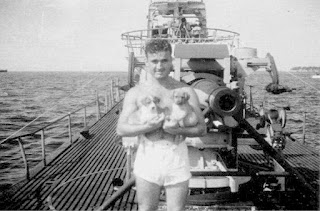
Jim Ellis holding Garbo's pups

While en route to Ulithi, Garbo gave birth to two puppies - the father was the mascot to the USS Tambor (SS-198). The puppies were later traded to other submarines for cases of beer. Garbo stayed with the sub for the rest of its war patrols, then returned to the States to live with Chief Motor Machinist Mate Jim Ellis.

2/22/21

Hound Dogs and Hush Puppies


The story of how Hush Puppies shoes got their name and how a Basset hound became their mascot begins with an early American food from the south called hush puppies (or hushpuppies).


There are many stories about the origin of hush puppies, a deep-fried cornmeal ball. According to the oldest, they originated in Nouvell Orleans  (now New Orleans) around the 1720s and became popular throughout the south. One day, an African cook in Atlanta was frying up a batch when a nearby puppy began barking. To quiet the dog, she gave it a plateful of the fried dough and said "hush puppy." Soon, hunters would hush their hound dogs with the southern cornballs.

In 1958, James Gaylord Muir, the first sales manager of the now famous Hush Puppies shoes, went on a selling trip in the south and heard the story of the food's origin. Because "barking dogs" is another name for sore feet, he thought the name Hush Puppies would be perfect for their shoes - people could "quiet their barking dogs" with their shoes.


5/9/20

Axelrod: Flying A's Worried Mascot


Axelrod, a Basset Hound, was famous in the 1960s for his worried look.


Flying A was a major gasoline brand from the 1930s to the 1960s. The theme for their advertising was not to worry as they will take care of your car's needs, and in the 1960s Axelrod became the perfect mascot because of his naturally worried look. He appeared in print ads in the Saturday Evening Post and in television commercials during sports events by his A-shaped doghouse with sayings like, "When it comes to your car...oooh, do we worry!" In 1966, Phillips Petroleum Co. bought out Flying A and Axelrod retired.

9/30/19

Steverino: The First Lady Greyhound Bus Mascot


First there was Steverino and then there was Lady Greyhound who bought much attention to the Greyhound bus company around the 1960s.


The company first began in 1914 and adopted the Greyhound name in 1929. The name came about when one of the drivers saw the reflection of his bus in a store window, reminding him of a greyhound dog. The running dog logo came out at that time, and its mascot didn't appear until 1957.


The future Greyhound mascot was born a pure bred but because she was a high-strung, nervous female she was not destined for the race track. Instead, she was sold to the bus-line. The first Greyhound TV commercial appeared during the Steve Allen show and their mascot was dubbed Steverino (Greyhound was the first transportation company to sponsor shows on television.) The 10 pound puppy quickly became famous and ended up with over 500,000 members in her fan clubs. After Greyhound ended their sponshorship of the Steve Allen show in the early 1960s, Steverino (Stevo) was renamed Lady Greyhound to the public. This announcement was made during a Jack Benny show.


Lady Greyhound, who was insured for $300,000, continued to travel across the country. She would make appearances at charity events and help inaugurate new bus terminals by biting through a ribbon of dog biscuits. Fifteen hundred people showed up at Detroit's opening to see Lady Greyhound and get her pawtograph. The famous dog made an appearance at the White House, was a regular guest on TV shows and even posed with Miss Universe Beauty Pageant contestants. She was great with the public and knew to freeze into a pose whenever she saw a photographer.


When Lady Greyhound traveled, she mostly went by charter-jet that included her own personal seat with safety belts because Greyhound had a rule against dogs. However, when the bus was not being operated publicly, she could ride on it. Wherever she traveled, she was to have the best accommodations possible. In addition, she was to get two hours of exercise every day and work for no more than an hour at a time.


Steverino retired in 1966 and two other greyhounds portrayed her until the ad campaign ended in 1970. Lorraine D'Essen of Animal Talent Scouts, who trained and cared for Lady Greyhound, kept Stevo after she retired. About a year before her retirement, Stevo gave birth to a litter of nine puppies. All the puppies were given away on Linkletter's TV show People are Funny to Brownies and Cub Scouts.

8/30/19

Honey Tree Evil Eye: Better Known as Spuds MacKenzie


We weren't suppose to know this, but the partying Spuds MacKenzie who liked his Bud Light was portrayed by a female dog named Honey Tree Evil Eye.


Honey Tree Evil Eye, a bull terrier, was born on October 7, 1983. Before she became famous as Budweiser's ultimate party animal, she was a show dog in Chicago. The unusually calm and photogenic dog caught the eyes of advertisers, and soon appeared on ads across college campuses. Her famous role didn't come until 1987.

A 23 year old art director, Jon Moore, created the Spuds MacKenzie mascot and campaign for Bud Light. The first TV ad appeared during Super Bowl XXI and was a huge hit. According to The New York Times, Bud Light sales increased by 20% between 1987 and 1988. The partying dog was soon on posters, t-shirts and other items, and the song Baby Got Back was written by Sir Mix-A-Lot to praise women who didn't look like the Spuds MacKenzie girls which he described as "little skinny chicks looking like stop signs, with big hair and skinny bodies."


Honey Tree Evil Eye's career as Budweiser's mascot didn't last long due to controversy. Republican Senator Strom Thurmond accused Anheuser Busch of glamorizing the use of alcohol and encouraging those who are under-aged to drink. Mother's Against Drunk Driving also campaigned against Spuds MacKenzie. Although the Federal Trade Commission found no evidence to support the allegations, Budweiser's ultimate party animal retired in 1989. Anheuser Busch felt that Spud's character had started to overshadow the product.

It was People magazine who revealed Spuds MacKenzie's gender in 1987. The truth was never supposed to be revealed.

Honey Tree Evil Eye died of renal failure on May 31, 1993.


7/24/18

Uga: Georgia's Bulldog


University of Georgia's famous mascot began over 60 years ago with a bulldog named Uga. His descendants and name continue the tradition today.


In 1956 Frank "Sonny" Seiler was a law student at the University of Georgia (UGA). He married that year and the couple was given a white English bulldog as a wedding gift. He took the dog to the first football game of the season and the head coach asked Seiler if his bulldog could be the school's mascot. Seiler agreed and a fellow student suggested naming the mascot Uga.

Uga (Hood's Ole Dan), the grandson of a bulldog that accompanied the Georgia football team to its Rose Bowl victory in 1943, was born on December 2, 1955. He was the University's mascot for ten years. According to Seiler, his wife made Uga's red jersey using a kid's t-shirt, and she had to make quite a few of them. "During the early games in Athens, especially the hot ones before he had a dog house, the large green hedges that surround Sanford Stadium afforded welcomed shade in the heat of battle. Unfortunately, the hedges constantly tore these jerseys and new ones had to be made."

Uga retired in 1966 and died peacefully on November 9, 1967 while sleeping in the sun in the Seiler's backyard in Savannah.

Since Uga I, nine Ugas followed - all descendants of Uga I and all owned by the Seiler family.

All Ugas who passed away are buried in marble vaults near the main entrance at the southwest corner of Sanford Stadium. Epitaphs to the dogs are inscribed in bronze, and before each home game, flowers and gifts are placed on their graves. The epitaph for Uga I is "DAMN GOOD DOG", the words the whole stand at the stadium shouted when his retirement was announced.


10/1/17

Jiggs: First USMC Mascot


During WWI, German reports called the attacking Marines teufel-hunden meaning devil-dogs. Soon afterward, an English bulldog wearing a Marine Corps helmet was depicted on a recruiting poster. A few years after WWI, Jiggs made history as the first unofficial mascot to the Marines.


The first dog to serve as the mascot to the United States Marine Corps was an English bulldog named King Bulwark. King, sired by a well known and famous dog named Rob Roy, was born on May 22, 1922. The pup, renamed Jiggs, was enlisted into the Corps on October 14, 1922 at a formal ceremony by Brigadier General Smedley Butler.

Private Jiggs, stationed at the Marine base in Quantico, Virginia, was quickly promoted to Corporal. Despite having been court-martialed several times for lack of proper manners, Jiggs was given the rank of Sergeant on New Year's Day in 1924 and Sergeant Major seven months later.

Jiggs was a pampered dog who liked living in the limelight. He attended football games to support his fellow Marines, and even starred in the 1926 movie Tell It To The Marines with Lon Chaney.

Jiggs passed away on January 9, 1927 - just four months shy of his fifth birthday. His satin-lined coffin laid in state at a hangar in Quantico, flanked by two Marine guards and surrounded by flowers from his many fans. He was mourned throughout the Corps and buried with full military honors.

The USMC's tradition of owning an English bulldog carries on to this day.


7/27/17

Shep: The Denver-Boulder Turnpike Dog


Shep became famous in history as a highway mascot who greeted motorists at the toll booths on the Denver-Boulder Turnpike.


In 1950, during the construction of the Boulder-Denver turnpike, a stray puppy wandered into the site where the workers would share bits of food with him. In 1952, when the turnpike opened to the motorists and the construction workers left, the timid dog began begging for food from the toll booth attendants. One cold night one of the attendant's working was able to coax the dog into his booth. The dog found a warm place to lie down and the attendant found company to better his night. Soon the dog, who was named Shep, became close friends with all the attendants.


Shep loved his new home and the motorists were thrilled to be greeted by the dog. In fact, drivers would pay a little extra to help buy dog food, give dog toys and treats, and even pull over to have their picture taken with Shep. It didn't take long for the Colorado Department of Transportation to make Shep the highway's unofficial mascot.

Despite all the love and attention Shep received, he still liked to roam off on his own at times but would always return. One day in 1958 he returned limping after he was mysteriously shot. Clyde Brunner, a Broomfield veterinarian, treated the dog for free and continued to donate his services for the rest of Shep's life.

In 1964, Shep was losing his sight and could barely get around. On August 3 of that year the men who loved and cared for him made the difficult decision to put Shep to sleep. The highway superintendent buried Shep next to the US 36 on-ramp. Two headstones were donated by residents, one with the inscription "Shep 1950-1964, Part Shepherd - Mostly Affection" and the other "Our Pal". Some suggested getting another toll booth dog but one attendant insisted "...nobody could take Shep's place...never".

The extra money the motorists paid, which was more than enough to feed and care for Shep, went towards the cost of the turnpike. In 1967, the turnpike was paid off, 13 years earlier than originally expected. In 2009, due to ongoing construction, Shep's grave was moved to Zang Spur Park, next to the Broomfield Depot Museum.

"He always wagged his tail at everyone who came by, and he was always happy," said Jane Spain, who helped lead the effort to move Shep's grave. "For everyone that went back and forth on the turnpike, he was their favorite thing."


4/6/17

Just Nuisance: Simon's Town Mascot


Just Nuisance became famous in history as the beloved mascot to the sailors in Simon's Town during WWII.


Just Nuisance was born on April Fool's day 1937 in Cape Town, South Africa. The Great Dane who grew to stand 6 feet 6 inches tall on his hind legs was sold to Benjamin Chaney. After buying the pup, Chaney relocated to the naval base in Simon's Town to run the United Services Institute where Royal Navy ships often docked.

When old enough to get around on his own, the gangly dog was allowed to roam freely. He quickly became friends with the sailors and would follow them around, including aboard their ships. He loved lying on the ship's deck, especially at the top of the gangplank making it difficult for the men to come on and off the ship. Because of this, the sailors affectionately began calling him Nuisance.


When the sailors were on leave, they would often take the train to Cape Town which was 22 miles away with many stations in between. Wanting to join in on the fun, Nuisance would hop aboard the train and the men would try their best to hide the big dog. When discovered, the conductor would force Nuisance off at the next stop but the determined dog would catch another train to meet up with his friends. Eventually, despite people willing to pay the dog's fare, Chaney was warned that if his dog did not stop boarding the train he would be put down. This upset many, including the sailors and local townspeople.

To solve the problem, Nuisance was officially enlisted in the Royal Navy on August 25, 1939, entitling him to ride on the trains for free. He underwent the required medical examination and even signed the enlistment papers with a paw print. Nuisance was given as his last name and Just as his first. His trade was listed as Bonecrusher and his religious affiliation as Scrounger which was later changed to Canine Divinity League (anti-vivisection) - one who opposes the practice of performing operations on live animals for the purpose of experimentation or scientific research.


Just Nuisance had his own bed on base but would sometimes sleep on a ship's bunk. On one occasion, a sailor had to sleep on the floor because the dog refused to leave the bed.


Just Nuisance, who was promoted to Able Seaman, never went to sea. His duties were ashore, watching over the sailors, boosting morale and helping to raise money for the war effort. He would attend promotional events, including parades and his own wedding to another Great Dane named Adinda. Just Nuisance soon became the proud father of five puppies, two of which were auctioned off in Cape Town by the Mayor for war funds.

Just Nuisance was good at watching over the men. He would break up bar fights and even escort drunken sailors back to the base. However, he had his own share of misdeeds such as boarding a train without his free pass, refusing to leave bars at closing time, going AWOL (absence without leave), losing his collar, and sleeping on a bed belonging to a Petty Officer.

Due to health problems caused by a car accident, Just Nuisance was discharged from the Navy in January 1944. His condition worsened and on April 1, his 7th birthday, he was put to sleep. The following day, his body was covered with a Royal Naval flag and buried with full military honors at Klaver Camp on top of Red Hill.

Just Nuisance became quite a celebrity in life. Tourists from around the world visit his gravesite, his statue on Jubilee Square, and the town's museum that has a special section honoring the Great Dane.


12/29/16

Handsome Dan: Yale's Famous Mascot


This champion show dog was the first Handsome Dan of Yale's long line of Olde English Bulldog mascots.


Many believe Handsome Dan was the first bulldog to represent Yale in 1889 but according to Yale Alumni Magazine (Nov/Dec 2014) recent research shows Handsome Dan had a predecessor, an English bulldog named Harper. An article published in Yale Daily News (November 22, 1890) states "Harper the Champion English bulldog will be taken to Springfield today as a mascot to the Yale team." The first record of Handsome Dan as a mascot is mentioned in Forest and Stream (June 23, 1892) saying Dan would be "the Yale mascot this year in the place of the champion Harper."

Handsome Dan may not have been Yale's first mascot, but his popularity earned him a place of honor in Yale athletics history. Andrew Graves, a prominent athlete who attended Yale, was the owner of the first Handsome Dan. Some sources say he bought the bulldog from a blacksmith for $5 but Yale Alumni Magazine says that is probably not true because, according to The American Kennel Club Stud Book, Handsome Dan's parents were pedigreed dogs bred by a William North of New Haven. Not only was Handsome Dan Yale's beloved mascot, he was a champion show dog who won at least 30 first prize ribbons over his lifetime.

Handsome Dan followed Graves everywhere around campus, including sporting events, and a strong bond was quickly developed between the bulldog and students. In fact, it was said Dan would never associate with anyone but students. Handsome Dan was adopted by the students as the Yale mascot, and the tradition of a bulldog being led across the field before football and baseball games began. One newspaper reported "He was a big white bulldog, with one of the greatest faces a dog of that breed ever carried."

Handsome Dan's fame was described in The Philadelphia Press: "A favorite trick was to tell him to 'Speak to Harvard.' He would bark ferociously and work himself into physical contortions of rage never before dreamed of by a dog."

After Graves graduated, Dan stayed on campus with his master's brother. In 1896 Graves brought Dan to live with him in England, where Handsome Dan died a year later at the age of 10. His body was stuffed and is in a sealed glass case in one of the trophy rooms of Yale's Payne Whitney Gymnasium, where "he is the perpetual guardian of the treasures which attest to generations of Yale athletic glory." (Stanton Ford)

After the death of Handsome Dan, the editor of the Hartford Courant wrote an editorial that testifies to the dog's unforgettable personality: "In personal appearance he seemed like a cross between an alligator and a horned frog, and he was called handsome by the metaphysicians under the law of compensation. The title came to him; he never sought it. He was always taken to games in a leash, and the Harvard football team for years owed its continued existence to the fact that the rope held.… If he has gone to that heaven which some humane people think exists for animals, we venture the prediction that there is music just now in the bulldog corner."

There was no successor to Handsome Dan I until 1933. On November 15, 2016 The Yale University Athletics Department announced the arrival of its new mascot, Handsome Dan XVIII.


7/30/16

Sinbad: A Coast Guard Mascot Who Liked to Have Fun


Sinbad was quite a character who became famous in history as a mascot in the US Coast Guard. He liked to party, raise some hell and keep his crew on the USS Campbell smiling.


Sinbad was originally intended to be a gift for a sailor's girlfriend in 1937. She was unable to keep the dog so the sailor snuck him on board the USS Campbell that night. Sinbad stayed quiet during the night but by morning his barking made his presence known. The sailors bonded quickly with the happy-go-lucky pup and Sinbad became a member of the crew. He was officially enlisted, with a paw print signature on his enlistment papers. He had his own service record, Red Cross and service IDs, and his own bunk.

Sinbad served 11 years as the ship's mascot during peace and war time. During WWII the ship would patrol the Atlantic ocean and was even awarded in 1943 for battling six enemy submarines over a 12 hour period, sinking at least one of them. During one battle, the ship was damaged and all but essential personnel were ordered off the ship while it was towed to safety for repair. Sinbad was one of the few who stayed on board. The sailors believed that as long as Sinbad was on board, the USS Campbell was unsinkable.

Sinbad saw plenty of combat action and was considered a valuable member of his crew. Actually, he spent most of his time of said action below deck, usually on one of the sailor's bunk covering his ears with his paws to block out the noise from gunfire. But when things quieted down he would join the men, prancing and barking to help lift their spirits.

Sinbad received six campaign ribbons and five battle stars during his time of service. He was a capable sailor when he was on duty but while on liberty he liked to have fun with the men. He would hang out in bars and night clubs, drink beer and whiskey, and flirt with the ladies. A few weeks after being promoted from First Class to K9C (Chief Dog - equivalent to Chief Petty Officer), he lost his promotion when the Captain broke him for insubordination. The mischievous dog also did some time in the brig for fraternizing with local pups while in Palermo.


Eddie Lloyd, editor of the old Coast Guard magazine, noted "Sinbad is a salty sailor but he's not a good sailor. He'll never rate gold hash marks nor good conduct medals. He's been on report several times and he's raised hell in a number of ports. On a few occasions, he has embarrassed the United States Government by creating disturbances in foreign zones. Perhaps that's why Coast Guardsmen love Sinbad, he's as bad as the worst and as good as the best of us."


Probably hung over after a night of partying

Despite disciplinary actions and demotions, Sinbad received an honorable discharge in 1948 as a Chief Dog (which he later earned back). Sinbad and Sergeant Stubby, are the only two animals to be classified as non-commissioned officers by the US military prior to the enactment of regulations to prohibit such.

After his retirement from the US Coast Guard, Sinbad spent the remaining years of his life at Barnegat Coast Guard Station in New Jersey. He passed away on December 30, 1951. He was laid to rest beneath the station’s flagstaff.


7/7/16

Nig: The Hoover Dam Mascot


Nig became famous in history as the mascot to the crew of Six Companies who built the Hoover Dam. The work was trying and risky, and the beloved dog who accompanied the men to work everyday helped make their lives a little easier.


In 1932 a Labrador mix puppy was born in the crawlspace beneath a building in Boulder City, the city that housed the men who built the Hoover Dam. The stray pup had free run of the city and quickly became well-liked by all. He was known as "nobody's dog and everybody's dog." One day a worker decided to take the puppy to the work site where he became a welcome addition to the workforce. The men called the dog Nig.

Nig joined the workers on the trip to the dam in the mornings and would ride back with them at the end of the work day. He became their mascot and could get around the canyon with much ease as he made his rounds to greet the workers. He would climb ladders, follow the men into the tunnels, and hop on the wooden platforms that lowered the men and equipment down into the canyon.

One day Nig wanted to return to the city earlier than usual and ended up getting a ride back with Frank Crowe, the chief engineer of the Hoover Dam. Even the big boss must have loved the dam's mascot a lot because the dog was seen sitting in the front passenger seat of the fancy car while the man's wife rode in the back.

The men would share their food with Nig and sometimes the food would be sweets. Once Nig ate so many candy bars he became ill. He was treated by the town's doctor and later an ad was placed in the local newspaper saying "I love candy but it makes me sick. It is also bad for my coat. Please don't feed me any more. Your friend, Nig". When Nig recovered, the men contributed money to improve the dog's diet. The city's mess hall prepared his meals and even packed a lunch for him in a special container to take to the dam. Nig would carry the container in his mouth when he boarded the transport truck to go to the dam, place the container alongside the worker's lunch pails when he got there, and would eat with the crew when the lunch whistle blew.

Nig was definitely part of the crew and was loved by all, except for one angry man. One day Nig was napping on a walkway when the mean worker ordered him to move out of his way. When Nig refused, the worker kicked him. Other workers saw this cruel act towards their friend and quickly pounced on the man. A ranger pulled the men off of him, and after learning why they were beating on him, the ranger escorted the man to the edge of town and told him never to come back.

After the dam was complete, Nig continued to make his rounds there. On February 21, 1941, an unseasonably hot day, Nig decided to take a nap in a spot of shade under a truck. When the driver of the truck returned, he failed to notice the sleeping dog. Nig died instantly when the truck ran over him. People were heartbroken when the news of the accident reached town. It was said to have been the saddest afternoon Boulder City had ever experienced. "Rough, tough rock-hard men wept openly and unashamed," a newspaper wrote.

Nig was buried in a concrete crypt at the edge of the cliff overlooking the dam so he could continue his oversight of the daily activities at the dam. The men who worked alongside Nig contributed what little money they had to buy a plaque memorializing the dog that meant so much to them.


In the late 1970s, a visitor to the dam felt the inscription on the plaque "NIG" was racist and he campaigned to have the plaque removed. The issue hit the national press and the plaque was later taken down. Many of the Boulder City and area residents, especially those who knew the dog, rose in protest to reinstate the plaque. A new plaque was placed that identifies Nig as the dam's mascot but does not mention his name.

5/28/16

Jack Brutus: Spanish-American War Mascot


Jack Brutus, also known as Old Jack, became famous in history as the official mascot for Company K, First Connecticut Volunteer Infantry.


Jack Brutus in uniform

Old Jack was born in Cumberland, Maine in 1891 and led an exciting life even before he served his country. According to George Thayer (who wrote a book about the history of Company K), "He [Jack] had friends in most of the cities in New England through his associations with the traveling public at the West End Hotel at Portland. Frequently he visited them in their own homes, taking passage in some steamer or boarding some train, and returning to Portland in due time."

In May 1898, Company K met Brutus at Fort Preble in Portland, Maine. The soldiers bonded quickly with the dog and declared him as their company's official mascot. Old Jack traveled with the men as they encamped at various places on the Eastern seaboard - from Maine to Virginia - providing coastal defense during the Spanish-American War.

Brutus was a large-breed dog and about seven years old during his service with Company K. While at Camp Alger near Falls Church, Virginia, he had a hard time tolerating the heat and the soldiers feared he would not survive. The men took well care of Jack and eventually he recovered. Old Jack also had a snoring problem that would wake the soldiers at night. A vote was taken on who was the "loudest snorer" in the camp and Brutus came in second place.

In late 1898, Wagoner Ahearn mustered out of the Army and took Jack home with him. While under a physician's care, Old Jack died from spinal problems on November 20 of that year. He was given a suitable burial and will always be remembered as a loyal war dog to the men in Company K.