Showing posts with label adventurous dogs. Show all posts

9/20/23

Titina: First Dog to Fly Over the North Pole


Titina made history by being the first dog to fly over the top of the world.


Umberto Nobile and Titina

Titina, a fox terrier, was a stray puppy who wandered the streets of Rome when she met Umberto Nobile, an Italian aviator and aeronautical engineer. The hungry puppy stood on her hind legs and pawed at Nobile, winning his heart. He scooped her up and named her Titina after Billy Murray's hit song Titina. The two bonded, and wherever Nobile went, his dog went with him.

In 1926, Nobile, Roald Amundsen (a Norwegian explorer leading this expedition and the leader of the first expedition to reach the South Pole) and 14 others set out on an airship to be the first to fly over the North Pole. Nobile brought his beloved dog with him despite objections from others - not everyone was happy with the presence of a dog because the small gondola hanging under the airship was already crowded with 16 men.


The airship, named Norge and designed by Nobile, left Italy and made it to Spitsbergen, the starting point of the North Pole Expedition. Before taking off, they learned that Richard Byrd's American expedition had successfully flown over the North Pole in a tri-motor airplane. Despite their disappointment, they went ahead with the flight. They took off on May 11, flew over the North Pole the following day, and landed two days later in Teller, Alaska.

Three explorers, including Byrd, claimed to be the first to reach the North Pole but disputes later arose over the legitimacy of their claims. Therefore, 
Amundsen is said to be the first verified explorer to have reached the North Pole.

Titina wasn't enthused about flying, but she was more than willing to go because of her love for her master. The journalist who was on board reported that Titina was "a dog marked by destiny, a dog of greatest character."


3/29/23

Tschingel: Famous Dog that Climbed the Alps


During her lifetime, Tschingel made 66 major ascents in the Alps - including 11 first ascents - in the 1860s and 70s.


At the age of six months, Tschingel did her first ascent in 1865. She and her master, Swiss alpine guide Christian Almer, climbed to the summit of Tschingel Col (elevation 7562) - from which she took her name. After the climb, Tschingel acted as a watchdog at Christian's home in Grindelwald and gave birth to many puppies. It was not until the summer of 1868 that she began a career in mountain climbing.

Christian and his son Ulrich were personal guides to Marguerite "Meta" Brevoort and her nephew William Coolidge. Meta, born in New York in 1825, began mountain climbing when she was about 40 years old and made a name for herself as a mountaineer in the late 1860s. Meta, William, the two guides and Tschingel did several first ascents in the Alps. The party called themselves the Tschingel Company.


Christian Almer, Ulrich Almer, Meta Brevoort, William Coolidge and Tschingel

In July 1868, the company had to give up climbing the Eiger due to dangerous ground conditions. William was greatly disappointed by the failure so Christian gave Tschingel to him as a gift. William later wrote:

"I do not clearly recollect hearing of Tschingel till July 11, 1868. That month Almer had for the first time become guide to my aunt, Miss Brevoort, and myself. On July 8 we all three made our first high climb together (the Wetterhorn) and on July 11 started from Little Scheidegg for the ascent of the Eiger. But the rocks (as often) were glazed, and we had to retreat. This disappointed me bitterly, for I was not quite eighteen years of age. Almer sympathised much with me, and so, as we were walking down that afternoon to Grindelwald, tried to comfort me by promising to give me his dog Tschingel, as one of her sons, Bello by name, was now able to act as his [Almer’s] watchdog."

Tschingel's first great climb was the Blümlisalphorn (elevation 12,011 feet). It was also nearly her last climb. According to William "She was very tired and her paws were cut by the ice. On the final slope she slipped, being still an inexperienced climber, and began to slide down the snow slopes, but was luckily rescued by one of our porters, who caught hold of her collar in the nick of time."

Tschingel's alpine skills improved as she continued to climb, and she had a "marvelous instinct for avoiding crevasses." In 1871, the company climbed the Eiger West Ridge, a very difficult ascent for a canine. "For the final ascent and for part of the descent she was roped. Although bleeding profusely in each of her paws she led the way over rocks and ice avoiding every crevasse. In short she was a born guide."

Tschingel climbed 66 major summits and about a hundred minor ones. She loved climbing and would beam with joy when she neared a summit. In 1875, she was elected as an honorary member of the Alpine Club - the first "female" member, as human females were not accepted into the Club until 1975.

Tschingel passed away in her sleep at home in England on June 16, 1879.


4/23/22

Charley: John Steinbeck's Traveling Companion


Charley, a "blue" standard poodle, accompanied John Steinbeck on his journey across the United States.


Charles le Chien, a.k.a. Charley, was born on the outskirts of Paris in 1950. The well-groomed poodle who took much pride in his looks, preferred the French language over English and did not like being subjected to baby talk because, according to Steinbeck, "he feels that he is a first-rate dog and has no wish to be a second-rate human."

Feeling like he had lost touch with his own country, Steinbeck decided to travel across the US "in search of America" in a pickup-camper with Charley. Charley loved going on road trips and was apparently worried during the planning and packing that he would be left behind. "During the weeks of preparation he was underfoot the whole time and made a damned nuisance of himself. He took to hiding in the truck, creeping in and trying to make himself look small."

The two left in the fall of 1960, driving from the east to the west to the south and back up to Long Island. The mission of his trip was to interact with the common people, and Charley, his "ambassador", was a great icebreaker when it came to talking to strangers.

Months later, Steinbeck recorded their journey in a book titled Travels with Charley: In Search of America. The book is more focused on the people than Charley, but one passage really brings out the personality of his beloved poodle: "Charley likes to get up early, and he likes me to get up early, too. And why shouldn’t he? Right after his breakfast he goes back to sleep. Over the years he has developed a number of innocent-appearing ways to get me up. He can shake himself and his collar loud enough to wake the dead. If that doesn’t work he gets a sneezing fit. But perhaps his most irritating method is to sit quietly beside the bed and stare into my face with a sweet and forgiving look on his face; I come out of deep sleep with the feeling of being looked at. But I have learned to keep my eyes tight shut. If I even blink he sneezes and stretches, and that night’s sleep is over for me. Often the war of wills goes on for quite a time, I squinching my eyes shut and he forgiving me, but he nearly always wins. He likes traveling so much he wanted to get started early, and early for Charley is the first tempering of darkness with the dawn."

Charley passed away shortly after their trip in 1961. John Steinbeck was awarded the Nobel Prize in Literature in 1962 for his realistic and imaginative writings, and died in 1968 at the age of 66. The pickup-camper (which Steinbeck named Rocinante, after Don Quixote's horse) was restored and is on display at the National Steinbeck Center in Salinas, California.


10/16/20

Hector: Did Psychic Powers Lead Him to His Master?


Hector, a black and white fox terrier, traveled thousands of miles on "the right" ship as a stowaway to reunite with his master.


Hector lived with his master, Willem H. Mante, on the cargo ship SS Simaloer. One day in 1922, when the freighter was docked at Vancouver, the outgoing dog who loved to wander the port cities did not arrive on time when the ship was due to leave. Mante was heartbroken but had no choice to leave his dog behind.

When Hector returned to the dock, he was observed boarding and disembarking several ships. Harold Kildall, who was overseeing the loading of cargo aboard the SS Hanley, was intrigued by the dog who seemed to have some purpose for his peculiar actions. Hours after the Hanley left Vancouver for Japan, Kildall was astonished to see Hector walking about on the deck. Fortunately, the Captain was a dog lover and welcomed the terrier aboard his ship. Kildall and Hector formed a bond, and each night the dog would stand watch with him.

About three weeks later, as the Hanley was unloading its cargo in Japan, Hector became excited when he noticed the Simaloer being berthed a few hundred yards away. Some of the crew (including Mante) boarded a sampan, and as the small boat neared the Hanley, Mante spotted his beloved dog and soon the two were happily reunited.

According to Dennis Bardens, author of Psychic Animals, "What puzzled the overjoyed Mante, was how the dog knew which vessel to choose at Vancouver. How did he know the Hanley was Japan-bound? There's no logical explanation, was all Mante could say. We can only marvel at the fact that it really happened."


9/29/19

Two Dogs Sailed the Mayflower


A 17th century journal confirms two dogs were on the Mayflower when it set sail to the New World in 1620.


According to a journal, at least two dogs accompanied the pilgrims on the 66 day voyage across the Atlantic from England to Cape Cod (now Provincetown, Massachusetts). One dog was a female mastiff and the other a spaniel, both belonging to John Goodman. It is believed the mastiff was brought along for protection and the spaniel for hunting. The name of the dogs are not mentioned.

One notable story took place in January 1621 when Goodman, his two dogs and another settler named Peter Brown got lost in the woods:


Friday, the 12th

This day two of our people put us in great sorrow and care; there was four sent to gather and cut thatch in the morning, and two of them, John Goodman and Peter Brown, having cut thatch all the forenoon, went to a further place, and willed the other two to bind up that which was cut and to follow them. So they did, being about a mile and a half from our plantation. But when the two came after, they could not find them, nor hear any thing of them at all, though they hallooed and shouted as loud as they could, so they returned to the company and told them of it. Whereupon Master Leaver and three or four more went to seek them, but could hear nothing of them, so they returning, sent more, but that night they could hear nothing at all of them. The next day they armed ten or twelve men out, verily thinking the Indians had surprised them. They went seeking seven or eight miles, but could neither see nor hear any thing at all, so they returned, with much discomfort to us all.

These two that were missed, at dinner time took their meat in their hands, and would go walk and refresh themselves. So going a little off they find a lake of water, and having a great mastiff bitch with them and a spaniel, by the water side they found a great deer; the dogs chased him, and they followed so far as they lost themselves and could not find the way back. They wandered all that afternoon being wet, and at night it did freeze and snow. They were slenderly appareled and had no weapons but each one his sickle, nor any victuals. They ranged up and down and could find none of the savages' habitations. When it drew to night they were much perplexed, for they could find neither harbor nor meat, but, in frost and snow were forced to make the earth their bed and the element their covering. And another thing did very much terrify them; they heard, as they thought, two lions roaring exceedingly for a long time together, and a third, that they thought was very near them. So not knowing what to do, they resolved to climb up into a tree as their safest refuge, though that would prove an intolerable cold lodging; so they stood at the tree's root, that when the lions came they might take their opportunity of climbing up. The bitch they were fain to hold by the neck, for she would have been gone to the lion; but it pleased God so to dispose, that the wild beasts came not. So they walked up and down under the tree all night; it was an extreme cold night. So soon as it was light they traveled again, passing by many lakes and brooks and woods, and in one place where the savages had burnt the space of five miles in length, which is a fine champaign country, and even. In the afternoon, it pleased God, from a high hill they discovered the two isles in the bay, and so that night got to the plantation, being ready to faint with travail and want of victuals, and almost famished with cold. John Goodman was fain to have his shoes cut off his feet they were so swelled with cold, and it was a long while after ere he was able to go; those on the shore were much comforted at their return, but they on the shipboard were grieved at deeming them lost.


John Goodman died shortly after, within the first year after having arrived on the Mayflower, and it is almost certain other settlers cared for the two dogs after his death because they were essential members of the colony.

3/17/18

Stickeen: Explored Alaska with John Muir


Stickeen became famous for the impact he had in John Muir's life during their Alaskan adventure in the late 1800s.


In 1880 John Muir (an environmental philosopher), Reverend S.H. Young, the Reverend's dog Stickeen and an Indian crew set out in a canoe from Fort Wrangell to explore the icy region of Alaska. When Muir saw the small black dog he told the Reverend it would be best to leave him behind. "This trip is not likely to be good for toy-dogs. The poor silly thing will be in rain and snow for weeks or months, and will require care like a baby." The Reverend assured him his dog would be alright.

Muir initially described the two year old dog as "a queer character -- odd, concealed, independent, keeping invincibly quiet, and doing many little puzzling things that piqued my curiosity." None of the men could figure out what he was good for. "He seemed to meet danger and hardships without anything like reason, insisted on having his own way, never obeyed an order, and the hunter could never set him on anything, or make him fetch the birds he shot."

Stickeen (named after the Indian tribe living near the fort) was mostly motionless on the canoe ride through the long channels and inlets of the Alaskan coast, but when a landing was about to happen he would plunge into the cold water and swim ashore as the canoe neared the beach. Stickeen was always the first out of the canoe, and the last to get in. When it was time to leave, Stickeen would hide in the brush and refuse to come when called. He would wait until the canoe was a fair way off then swim to the boat, knowing the men would stop their rowing and bring him aboard. Hoping to put a stop to this, the men would keep rowing farther out so the dog would think they were abandoning him. The ploy did not work - "the longer the swim the better he seemed to like it."

Stickeen took a liking to Muir and began following him on all his hikes, no matter how tough the terrain. Once, Muir had to make a set of moccasins out of a handkerchief for him to wear because his injured paws were leaving behind a trail of blood. "However great his troubles he never asked for help or made any complaint, as if, like a philosopher, he had learned that without hard work and suffering there could be no pleasure worth having."

One morning, Muir set out on his own to explore a large glacier during a blizzard, a journey that was surely not meant for a small dog. His hope was to leave Stickeen behind but the determined dog insisted on going. Stickeen followed Muir without effort as they crossed flooded streams, hiked up and down icy slopes, and leapt over deep crevasses - until they came upon a crevasse that was too wide to leap. Instead, they would have to climb down an ice wall, cross over on a sliver of ice, then climb up an ice wall to reach the other side. For the first time, Muir saw a troubled look on the dog's face as he looked into the crevasse. He whined, and ran back and forth frantically in search of a safer way to cross. "His looks and tones of voice when he began to complain and speak his fears were so human that I unconsciously talked to him in sympathy as I would to a frightened boy." When Muir made it to the other side, it took a long time for him to finally convince the scared dog to cross. Stickeen did make it over to the other side, and the moment he knew he was safe he became over excited with happiness. "Never before or since have I seen anything like so passionate a revulsion from the depths of despair to exultant, triumphant, uncontrollable joy."

The two made it back safely to camp that night, and the once independent dog did not want to leave Muir's side during the rest of the trip. "I have known many dogs, and many a story I could tell of their wisdom and devotion; but to none do I owe so much as to Stickeen."


I want to thank Jim Lawrence for bringing this story to my attention.

5/30/17

Jeff: Died Doing What He Loved to Do


Jeff made history for his love of parachuting and unfortunate death.


Jeff, a pit bull, was the mascot of the 120th observation squadron of the Colorado Air National Guard. Not only did Jeff help boost morale among his fellow men, the adventurous dog loved jumping out of the planes with them. Outfitted with his own parachutes, Jeff successfully jumped at least 100 times before his fateful day.

On August 16, 1924 Jeff was to parachute from a plane during an air show at Lowry Field in Denver. When asked about Jeff's safety, an aviator responded, "It would break Jeff's heart if he missed a jump on an occasion like this." Jeff was taken up some 3000 feet by pilot Sergeant Kerns, jumped as usual, and sadly plunged to his death when his parachute failed to open. Army Sergeant J. C. Ziegler, Jeff's owner, pushed through the crowd and gathered the body of his beloved dog in his arms.

Jeff was laid to rest by the men who regarded the dog as one of their own - the dog who died doing what he loved to do.


1/26/17

Igloo: American Polar Explorer


Igloo became famous in history for accompanying his master Richard Byrd on his expeditions to the North and South Poles.


Igloo and Richard Byrd

In the winter of 1926, Maris Boggs found a stray terrier puppy shivering on the streets of Washington DC. Unable to keep the pup, she convinced Richard Byrd to take him and include him on his upcoming expedition to the Arctic.

That April, Byrd, his crew and his newly adopted dog (given the name Igloo by the ship's crew) set sail to Norway, where Byrd would challenge Roald Amundsen, a Norwegian explorer, to become the first man to fly over the North Pole. Byrd made the 15 1/2 hour flight, and Igloo was there to congratulate him on his victory - disputes later arose over the legitimacy of Byrd actually reaching the North Pole.

Igloo's second great adventure was in 1928 when Byrd began his first Antarctic expedition. This was the largest and most expensive expedition to Antarctica, consisting of two ships, three airplanes, 95 sled dogs and 650 tons of supplies. The goals of the expedition were to make the first flight over the South Pole and to bring experts to study the unknown territory. A base camp named Little America was constructed near the edge of the Ross Ice Shelf on the Bay of Whales, housing 42 men.


Dogs were common on polar expeditions during this period, but not fox terriers. The little dog could not tolerate sub-zero temperatures like the sled dogs so he wore a specially made jacket and booties to keep him warm. Igloo, nicknamed Iggy, did not pull a sled, but the entertaining dog did serve a valuable purpose there by boosting crew morale during the isolation of their long expedition.

A description of Igloo encountering snow for the first time:

"The soft, yielding resistance of the snow was delicious to his paws. He sniffed it gingerly, then a red tongue emerged for a tentative lick. The sharp coldness took him by surprise... he emerged in a flurry of crystals, made a bee-line dash to the shack at the crest of the slope, then swept into a series of concentric circles that ultimately ended in his becoming a whirling dervish, enveloped in a minor snow storm of his own making."

In November 1929 Byrd successfully flew to the South Pole and back, and in June 1930 the expedition returned to the US. Byrd was given a hero's welcome, and Igloo was at Byrd's side as they rode down Broadway in NYC during a ticker tape parade.

In April 1931, while Byrd was away on a speaking engagement, Igloo became ill. After hearing the news, Byrd cancelled his lectures to return home. Sadly, Igloo died before he made it home.


Igloo was buried in the Pine Ridge Cemetery for Small Animals in Massachusetts. His headstone is in the shape of an iceberg, and on the stone is a bronze plaque with the inscription "He was more than a friend". TIME magazine and newspapers across the country covered Igloo's death, and Byrd received thousands of letters of condolences written by children from around the world.

Later, Byrd's hometown of Winchester, Virginia erected a life size statue of Byrd with Igloo by his side (using the top photo) in front of the Court house.


1/7/17

Robot: Discovers Lascaux Cave Paintings


Robot became famous in history for discovering one of the greatest collections of prehistoric artwork.


In September 1940, four teenage boys (Marcel Ravidat, Jacques Marsal, Georges Agnel and Simon Coencas) and Ravidat's dog Robot set out on an adventure in the Dordogne region of southwestern France to search for treasure. According to an old legend, the treasure was hidden in an underground passage deep in the woods of Montignac.

As they walked through the dense brush, Robot found a small hole next to an uprooted tree. The boys enlarged the hole and slid into a dark chamber beneath the ground. Their hopes of finding treasure happened. The treasure was a collection of ancient artwork dating back to at least 17,000 years. Marsal would later say that they could see a "cavalcade of animals larger than life painted on the walls and ceiling of the cave - each animal seemed to be moving."


Lascaux cave, 1940

Some 600 paintings and nearly 1,500 engravings decorate the interior walls of Lascaux cave. The displays depict many animals, some abstract symbols and one human (painted representations of humans are rare in Paleolithic art). The cave was opened to the public in 1948, causing the artwork to deteriorate. In 1963, to protect the artwork from further deterioration, the cave closed to the public. In 1983, a replica cave, known as Lascaux II, opened to allow tourists to have some experience of the original.

7/25/16

Bob: The Dog Who Loved Trains


Bob became famous in history as the free spirited dog who loved to travel on trains in Australia during the late 1800s.


According to William Seth Ferry, the first time he saw the scruffy mixed breed puppy was in a cattle truck at Terowie (where he was a special guard with the railway) with about 50 other stray dogs from Adelaide who were destined to become rabbit hunters. Ferry took a fancy to the pup and offered to buy him from the rabbiter. Several sources say the rabbiter refused to sell him but said he would swap him for another dog so Ferry found a stray dog loitering by a police station and made the swap. However, according to Olwyn Parker, author of The Railway Dog, Ferry paid five bob for the puppy, hence he got his name.

For five years Bob lived with Ferry, first in Terowie then in Petersburg (now Peterborough). He followed Ferry to work and rode with him in the guard's van, sometimes in the engine car, traveling thousands of miles around the South Australian countryside. Bob eventually became a free spirit, hopping on trains by himself, so when Ferry was promoted to Assistant Station Master in Western Australia in 1889 he decided to leave the adventurous dog behind with the railway men.

Bob traveled far and wide but he would always come back to his home base around Petersburg. He loved riding the trains, his favorite seat being on top of the coal box, and he loved the men that worked on them. At night, Bob would follow one of the railway workers, usually the driver, to his home where he would be fed and looked after. Bob was a real charmer and became well known in the towns he passed through - the sight of a dog on top of the coal fender brought much joy to adults and children alike.


Bob lying on top of the train

In 1939, The Advertiser said Bob traveled freely "like politicians" on the trains, suburban trams and even the Murray steamers, and attended official functions: "He was a guest at the banquet for the opening of the railway from Peterborough to Broken Hill and appeared at the opening of the Hawkesbury Bridge in New South Wales."

Bob was well-liked by the travelers and the children adored him. The kind-hearted dog made many friends during his travels and even helped, at least one man, during a difficult time. Bob sat next to the man, Thomas McMurtrie, who was lost in grief after the death of his daughter-in-law and five grandchildren in a diphtheria outbreak. Parker wrote in her book "The man gave little sign of having noticed the dog’s presence, except once or twice when his hand came down and rested gently on Bob’s head - just for a moment, but the comfort was mutual ... This dog, though he’d never know it, had saved his sanity these past long hours."

In 1892, Bob disappeared for four months. He was taken by a sheep farmer and it is not sure if Bob escaped or was seen by one of the railway men. Parker thinks he was spotted when he came into town with a mob of sheep and the railway men angrily took back their dog from the sheep farmer. After this incident one of Bob's friends, a commercial traveler, had a special collar made for him with the following inscription: STOP ME NOT BUT LET ME JOG FOR I AM BOB THE DRIVERS DOG - SAR (South Australian Railways).

Bob died in 1895 at the approximate age of 13 years. His collar is on display in the National Railway Museum in Port Adelaide and in 2009 the people in Peterborough and wider South Australia raised funds for a statue of Bob.


6/12/16

Seaman: Dog of the Lewis and Clark Expedition


Seaman, called the Dog of Discovery, became famous for his travels with Lewis and Clark on their historic journey into the unknown.


Before Lewis and Clark started their great expedition across North America, Captain Meriwether Lewis purchased a Newfoundland dog for $20. It is unsure why he chose that breed of dog, but some believe Lewis was influenced by the breed's reputation of size, strength and swimming abilities. The dog was named Seaman - in 1916 the dog's name was believed to have been Scannon (Lewis's handwriting was misinterpreted by a historian) and in 1987 the mistake was discovered and the dog's name was proved rightly to be Seaman.

Lewis, Second Lieutenant William Clark and their crew departed from Pittsburgh on August 30, 1803 (the official launch took place just outside St. Louis in the summer of 1804). On the long and difficult journey Seaman was of great help to the men during their adventure. He retrieved game, including fat squirrels that Lewis thought was pleasant food when fried, and he guarded their camps against animal intruders, particularly grizzly bears and buffalo. According to one journal, Seaman was credited with saving several lives from a buffalo bull. The great beast charged through the camp one night and the dog was able to steer him away from the men. The Native American Indians were fascinated by Seaman, having never seen a dog like him before. One Indian offered three beaver skins for the dog, which Lewis refused.

Life wasn't easy for Seaman during the expedition. He often suffered from the heat due to his heavy coat and at times the mosquitoes were so abundant Lewis wrote "my dog even howls with the torture he experiences from them." Another burden was the barbed seeds of the foxtail that would penetrate the skin causing much pain. Once, a beaver bit Seaman in his hind leg, severing an artery. Lewis feared his dog would not survive. However, with extraordinary medical measures, Seaman made a full recovery.

The last entry in Lewis's journal regarding Seaman was written on July 15, 1806. No one is certain what happened to Seaman after that, but a book published in 1814 by educator Timothy Alden leads us to believe that Seaman survived the trip and continued to make his life with Lewis. In the book, Alden mentions an inscription on a dog collar that was donated to a museum in Alexandria, Virginia. The inscription read (exact wording):

"The greatest traveller of my species. My name is SEAMAN, the dog of captain Meriwether Lewis, whom I accompanied to the Pacifick ocean through the interior of the continent of North America."

Unfortunately the collar cannot be found. Many artifacts were lost when the museum suffered a fire in 1871.

The following was also noted in Alden's book:

“The fidelity and attachment of this animal were remarkable. After the melancholy exit of gov. Lewis [who died in 1809], his dog would not depart for a moment from his lifeless remains; and when they were deposited in the earth no gentle means could draw him from the spot of interment. He refused to take every kind of food, which was offered him, and actually pined away and died with grief upon his master’s grave.”


Several statues and monuments have been dedicated to Seaman, the adventurous dog who helped explore new land.

4/10/16

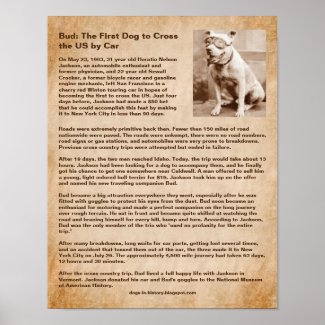
Bud: The First Dog to Cross the US by Car


Bud became famous in history as the first dog to make a long journey by car from Idaho to New York City.


On May 23, 1903, 31 year old Horatio Nelson Jackson, an automobile enthusiast and former physician, and 22 year old Sewall Crocker, a former bicycle racer and gasoline engine mechanic, left San Francisco in a cherry red Winton touring car in hopes of becoming the first to cross the US. Just four days before, Jackson had made a $50 bet that he could accomplish this feat by making it to New York City in less than 90 days.


Winton touring car with Bud in the driver's seat

Roads were extremely primitive back then. Fewer than 150 miles of road nationwide were paved. The roads were unkempt, there were no road numbers, road signs or gas stations, and automobiles were very prone to breakdowns. Previous cross-country trips were attempted but ended in failure.

After 19 days, the two men reached Idaho. Today, the trip would take about 13 hours. Jackson had been looking for a dog to accompany them, and he finally got his chance to get one somewhere near Caldwell. A man offered to sell him a young, light colored bull terrier for $15 (equivalent to about $400 today). Jackson took him up on the offer and named his new traveling companion Bud.

Bud became a big attraction everywhere they went, especially after he was fitted with goggles to protect his eyes from the dust. Bud soon became an enthusiast for motoring and made a perfect companion on the long journey over rough terrain. He sat in front and became quite skilled at watching the road and bracing himself for every hill, bump and turn. According to Jackson, Bud was the only member of the trio who "used no profanity for the entire trip."

After many breakdowns, long waits for car parts, getting lost several times, and an accident that tossed them out of the car, the three made it to New York City on July 26. The approximately 4,500 mile journey had taken 63 days, 12 hours and 30 minutes.

After the cross-country trip, Bud lived a full happy life with Jackson in Vermont. Jackson donated his car and Bud's goggles to the National Museum of American History.


3/26/16

Bobbie the Wonder Dog: Walks 2,500 Miles


Bobbie was a determined dog who became famous in history after walking thousands of miles to get back home.


Bobbie & Frank Brazier

In the summer of 1923, Frank and Elizabeth Brazier left their home in Silverton, Oregon to visit their old home town in Indiana. Bobbie, their two year old Scotch collie mix, accompanied them on the trip. They headed east in their Overland Red Bird touring car, with Bobbie staying in the back on top of the luggage or on the car's running board.


Bobbie on his owner's car in Silverton

During the first stop in Indiana, three dogs jumped Bobbie and chased him away while Frank was filling the car with gas. Frank and Elizabeth were not worried at the time, thinking Bobbie could take care of himself and would show up later at the house they were staying. When he didn't show up, they started searching for him, and even advertised their missing dog in the local newspaper. The Braziers eventually headed to their old home town, leaving instructions to hang onto Bobbie if he reappeared and they will pick him up on their way back to Oregon. When they headed back, their beloved dog had not been found. The Braziers, brokenhearted, continued on their way home. They left instructions to send Bobbie home on a rail car if he should turn up.

Six months later, Elizabeth's daughter from a previous marriage, Nova Baumgarten, spotted Bobbie walking down a street in Silverton. He was scrawny, his coat was matted, and his toenails were worn down to nothing. Nova brought Bobbie to the restaurant the Braziers owned for a joyful reunion. Bobbie became an overnight sensation, and within a week the story of his long journey was making national headlines.

People who took Bobbie in for a night or two on his way home wrote in to tell their stories - they were able to identify him by several distinguishing marks. These stories helped the Humane Society of Portland to piece together a surprisingly precise account of the route Bobbie took. He traveled more than 2,500 miles of plains, desert and mountains, averaging 14 miles per day.

Correspondence from around the world poured in addressed to "Bobbie the Wonder Dog". Bobbie received medals, keys to cities, and a jewel-studded harness and collar. He was honored as the star of the Home Beautifying Exposition in Portland where over 40,000 people came to see him, and was given his own dog-sized bungalow. His story was featured in Ripley's Believe It or Not and a book titled Bobbie, a Great Collie by Charles Alexander. He was also featured in a silent film called The Call of the West, with Bobbie playing his part.

In 1927, only six years old, Bobbie became sick and passed away. Some doctors suggested it was the strain of his journey catching up with him. He was buried with honors at the animal cemetery of the Oregon Humane Society in Portland. Hundreds of people attended his funeral, and the city's mayor delivered the eulogy. The famous Hollywood dog star Rin Tin Tin laid a wreath at his grave.