7/28/25

Charlie: Played a Part in Preventing a Nuclear War


Charlie helped calm John F. Kennedy during a difficult time when the country feared a nuclear war.


JFK and Charlie

Cuba's president Fidel Castro feared the US was going to invade his country so he sought assistance from the Soviet Union. In May 1962, the Soviet Union began to ship nuclear missiles to Cuba. This led to the Cuban Missile Crisis, a 13-day confrontation (October 16 to 28) between the governments of the US and the Soviet Union. An agreement was reached between Kennedy and Khrushchev - Cuba agreed to remove its missiles and the US agreed not to invade Cuba.

JFK had nine dogs while in the White House. He loved them all, but according to multiple sources, Charlie (a Welsh terrier) was his favorite. During those 13 stressful days at critical meetings, Charlie would lay on his master's lap. After petting his dog for a while, the president relaxed. According to the White House kennel keeper, he was to come get Charlie as Kennedy calmly said, "I suppose that it's time to make some decisions."

Research has shown that simply petting a dog lowers levels of cortisol (a stress-related hormone) and decreases blood pressure. Thanks to Charlie, the president of the United States was able to remain calm while making an important decision to prevent a nuclear war.

12/7/24

Ashley Whippet: First Notable Disc Dog


Ashley Whippet was not the first dog to catch a flying disc (frisbee), but he did help popularize the sport.


Alex Stein and Ashley Whippet

On August 5, 1974, 19-year-old Alex Stein smuggled his dog Ashley Whippet into Dodger Stadium where the baseball game between the LA Dodgers and the Cincinnati Reds were being televised nationally. During the seventh inning stretch, Stein jumped over the infield wall and went onto the field (uninvited) with Ashley where he threw discs for his dog to catch. The crowd was amazed with Ashley's ability to run up to 35 mph and leap up to nine feet in the air to catch the discs. The two performed for eight minutes before Stein was escorted off the field and arrested.

Stein, Irv Lander (a consultant to Wham-O - the maker of the Frisbee) and Eldon McIntire (a dog trainer and a frisbee enthusiast) organized the first Frisbee Dog World Championship in 1975. Stein and Ashley won the first three championships in 1975, 1976 and 1977. In the early 1980s, the competition series was renamed the Ashley Whippet Invitational in honor of Ashley.

Ashley died in Stein's arms in March 1985 of natural causes at age 13. Sports Illustrated eulogized him.


7/11/24

Mr. Barbo: Mount Equinox's Beloved Dog


Thousands visit Mr. Barbo's gravesite every year atop Mount Equinox in beautiful Vermont.


Joseph George Davidson was a chemist and inventor who was partly responsible in the development of mustard gas during WWI and the atomic bomb during WWII - two destructive acts in human history that bore heavily on his conscience. In the 1940s, he began buying tracts of land on Mount Equinox, one of Vermont's tallest mountains. In the 1950s, Davidson, his wife and his beloved dog Mr. Barbo, a Norwegian Elkhound and Siberian Husky mix, moved to the land in their mountain top home. By the time he retired in the 1960s, he owned almost 11 square miles of land.

In November 1955, during the deer hunting season, 12 yo Mr. Barbo was shot and killed by a hunter. Davidson was heartbroken and livid. He banned hunting on his property and hired a sheriff's deputy to enforce it. He also offered a reward for the assailant's identity, who had never been found.

A granite monument stands at Mr. Barbo's gravesite on the mountain with the inscription: "We loved him and he repaid that love with an adoring devotion that only a dog could give. Shot and killed by a malicious hunter Nov. 24, 1955."

Davidson passed away in 1969, and his land was donated to an order of Carthusian monks - the Charterhouse of the Transfiguration is the only Carthusian monastery in the U.S. "No Hunting" signs remain to this day and the monks still keep up Mr. Barbo's grave.


5/14/24

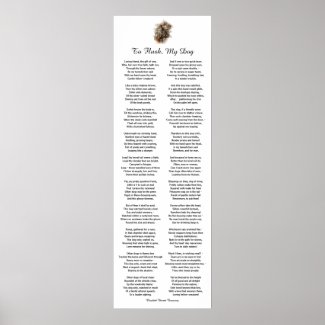
Flush: Elizabeth Barrett Browning's Dog


Elizabeth Barrett Browning, an English poet of the Victorian era, loved dogs and was inspired to write a 20-stanza poem about her beloved cocker spaniel Flush.


Elizabeth had received Flush from a good friend and fellow writer, Miss Mary Russell Mitford. The two bonded quickly, and it didn't take long for her to spoil the adorable cocker spaniel. She would hand feed him cakes, custards and scraps of beef, and because her doctor did not approve of the dog sleeping on the sofa with her, she would bathe him daily so he could.

Flush was stolen from Elizabeth three times. The first theft was in 1843. Because her father refused to pay the full ransom, Elizabeth defied his wishes and secretly arranged for full payment. The third time was less than two weeks before she married Robert Browning, also an English poet. The ransom was paid and Flush was returned five days before the wedding in 1846.

Flush was not happy when Robert first came into Elizabeth's life. He did not like having to share his mistress with him, and despite Robert trying to win his affection with treats, the jealous dog bit him a couple of times. It wasn't until after the wedding that Flush eventually became friends with Robert and the two would go on long walks together.

To Flush, My Dog

Loving friend, the gift of one,
Who, her own true faith, hath run,
Through thy lower nature;
Be my benediction said
With my hand upon thy head,
Gentle fellow-creature!

Like a lady's ringlets brown,
Flow thy silken ears adown
Either side demurely,
Of thy silver-suited breast
Shining out from all the rest
Of thy body purely.

Darkly brown thy body is,
Till the sunshine, striking this,
Alchemize its dulness, -
When the sleek curls manifold
Flash all over into gold,
With a burnished fulness.

Underneath my stroking hand,
Startled eyes of hazel bland
Kindling, growing larger, -
Up thou leapest with a spring,
Full of prank and curvetting,
Leaping like a charger.

Leap! thy broad tail waves a light;
Leap! thy slender feet are bright,
Canopied in fringes.
Leap - those tasselled ears of thine
Flicker strangely, fair and fine,
Down their golden inches.

Yet, my pretty sportive friend,
Little is 't to such an end
That I praise thy rareness!
Other dogs may be thy peers
Haply in these drooping ears,
And this glossy fairness.

But of thee it shall be said,
This dog watched beside a bed
Day and night unweary, -
Watched within a curtained room,
Where no sunbeam brake the gloom
Round the sick and dreary.

Roses, gathered for a vase,
In that chamber died apace,
Beam and breeze resigning -
This dog only, waited on,
Knowing that when light is gone,
Love remains for shining.

Other dogs in thymy dew
Tracked the hares and followed through
Sunny moor or meadow -
This dog only, crept and crept
Next a languid cheek that slept,
Sharing in the shadow.

Other dogs of loyal cheer
Bounded at the whistle clear,
Up the woodside hieing -
This dog only, watched in reach
Of a faintly uttered speech,
Or a louder sighing.

And if one or two quick tears
Dropped upon his glossy ears,
Or a sigh came double, -
Up he sprang in eager haste,
Fawning, fondling, breathing fast,
In a tender trouble.

And this dog was satisfied,
If a pale thin hand would glide,
Down his dewlaps sloping, -
Which he pushed his nose within,
After, - platforming his chin
On the palm left open.

This dog, if a friendly voice
Call him now to blyther choice
Than such chamber-keeping,
'Come out!' praying from the door, -
Presseth backward as before,
Up against me leaping.

Therefore to this dog will I,
Tenderly not scornfully,
Render praise and favour!
With my hand upon his head,
Is my benediction said
Therefore, and for ever.

And because he loves me so,
Better than his kind will do
Often, man or woman,
Give I back more love again
Than dogs often take of men, -
Leaning from my Human.

Blessings on thee, dog of mine,
Pretty collars make thee fine,
Sugared milk make fat thee!
Pleasures wag on in thy tail -
Hands of gentle motion fail
Nevermore, to pat thee!

Downy pillow take thy head,
Silken coverlid bestead,
Sunshine help thy sleeping!
No fly's buzzing wake thee up -
No man break thy purple cup,
Set for drinking deep in.

Whiskered cats arointed flee -
Sturdy stoppers keep from thee
Cologne distillations;
Nuts lie in thy path for stones,
And thy feast-day macaroons
Turn to daily rations!

Mock I thee, in wishing weal? -
Tears are in my eyes to feel
Thou art made so straightly,
Blessing needs must straighten too, -
Little canst thou joy or do,
Thou who lovest greatly.

Yet be blessed to the height
Of all good and all delight
Pervious to thy nature, -
Only loved beyond that line,
With a love that answers thine,
Loving fellow-creature!


Virginia Woolf wrote a biography of Flush which was a best-seller when it was published in 1933, and a canine actor played the role of Flush in the 1934 movie "The Barretts of Wimpole Street".

4/22/24

Hatch: Found Over 400 Years After the Mary Rose Sunk


The skeleton of a sea dog was found during the excavation of the Mary Rose, a warship of King Henry VIII's fleet that sank during the Battle of the Solent on July 19, 1545.


The wreck of the Mary Rose was located in 1971. During the underwater excavation, a well-preserved skeleton of the ship's dog was discovered in 1981. Because the skeleton was found near a sliding hatch door, the research team named the dog Hatch. According to DNA, Hatch was a male and between 1 1/2 to 2 years old. The testing also suggested he shared many genetic characteristics with the modern breed of Jack Russell. Other characteristics showed he was most likely a cross-breed with a whippet, but with a long and curly brown coat.

During the time of the Mary Rose, cats were believed to bring bad luck, so Hatch was on board to kill rodents. He apparently did a very good job because no complete rat skeletons were found during the excavations.

The hull of the Mary Rose was raised in 1982 - it, many artifacts and Hatch's skeleton are on display in the Mary Rose Museum in Portsmouth, England.


3/25/24

Clothing Naked Animals


A bogus organization in the mid 1900's campaigned to clothe naked dogs and other animals for the sake of decency.


A Dog in Boxer Shorts
appeared in an article with instructions on how to make the boxers


In 1959, comedian and prankster Alan Abel created a hoax about an organization called the Society for Indecency to Naked Animals (SINA). Using the language of conservative moralists opposed to the changes in postwar society, he argued that 'naked' animals, including pets, farm animals and those in zoos, were scandalous and needed to be clothed. Abel employed actor Buck Henry to play the organization's president, G. Clifford Prout, who gave interviews in television news and talk shows.


Supporters marching in front of the White House

The organization was taken seriously, and SINA actually acquired over 50,000 members. According to Abel, "It was outrageous - the people around the country really seriously believe that this campaign to clothe naked animals was justified..." Some even contributed large sums of money (including a $40,000 check), which was returned to prevent being charged with fraud by accepting donations for a bogus charity.

The hoax was finally exposed in 1962 when a staff member recognized Buck Henry while giving an interview as Prout by Walter Cronkite. "When Cronkite eventually found out that he’d been conned, and I was the guy behind it, he called me up. I’d never heard him that angry on TV—not about Hitler, Saddam Hussein, or Fidel Castro. He was furious with me," said Abel.

In 1963, Time magazine formally exposed the hoax, and Abel revealed the true message of his operation: SINA wasn’t just a hoax — it was a commentary on the state of affairs in America. "I had no interest in actually putting shorts on horses, or mumus on cows. SINA was a satirical riff on censorship: it mocked the moral maniacs who were banning films, books, records, and plays during that time period."


3/3/24

Dogs in Charles Lindbergh's Life


Charles Lindbergh was born in 1902 and grew up as an ordinary boy on a farm in Minnesota. In 1927, he became the first aviator to complete a nonstop solo transatlantic flight from New York to Paris. He became an international hero and later wrote a Pulitzer Prize-winning book about the experience. In 1932, his 20 month old baby boy, Charles Lindbergh Jr., was kidnapped and killed. Partly because of his popularity, the crime and its aftermath sparked a media frenzy and the first "Trial of the Century." Late in life, he became concerned that modern technology was taking a toll on the world's plants and animals. He became a conservationist, arguing that he would rather have "birds than airplanes." Lindbergh died in 1974 at the age of 72.

Below are photos of some of the dogs in Charles Lindbergh's life:


Charles Lindbergh and his dog Spot 1910


Charles Lindbergh and his dog Dingo 1912


Charles Lindbergh at Lambert Field in St. Louis before proceeding to NY for the New York-Paris flight 1927


Charles Lindbergh Jr. with family dogs Bogey and Skean 1931

1/15/24

Photograph of Kamikaze Pilots and Puppy


About 3,800 Japanese pilots died in kamikaze attacks during WWII.


Kamikaze pilots petting a puppy the day before their final mission.

Most kamikaze pilots were 17-24 years old. While some were volunteers, others felt pressure to sacrifice their lives for their country.

1/9/24

Jimmy: Demonstrates Early EKG Machine


Jimmy helped demonstrate an early version of an electrocardiogram (ECG or EKG), a machine that measures the electrical activity of the heart.


A demonstration to the Royal Society by Waller's dog Jimmy (1909)

Today's EKG machine has come a long way, thanks to many scientists and inventors. The first machine was invented in 1903. It weighed about 600 pounds and required patients to put their limbs into buckets of salt water.

The first practical EKG machine with surface electrodes was created by Augustus Desiré Waller. He lectured on it in Europe and America, often using his pet bulldog Jimmy in his demonstrations. The Times newspaper reported that the demonstration had caused debate in parliament over whether the Cruelty to Animals Act had been violated. The Secretary of State replied as follows: I understand the dog stood for some time in water to which sodium chloride had been added or in other words a little common salt. If my honourable friend has ever paddled in the sea he will understand the sensation. (Laughter) The dog — a finely developed bulldog — was neither tied nor muzzled. He wore a leather collar ornamented with brass studs. Had the experiment been painful the pain would no doubt have been immediately felt by those nearest the dog. (Laughter)

Today's EKG machines weigh just a few pounds and have played a central role in checking for signs of heart disease.


11/28/23

Dave: Annie Oakley's Wonder Dog


The famous Annie Oakley was so confident of her sharpshooting skills that she included her beloved dog Dave in her acts.


Annie Oakley and Dave

Annie Oakley began shooting and hunting at an early age to help put food on the table for her impoverished family. She used an old muzzle-loading gun that belonged to her deceased father, and was so good at shooting that she was able to help provide a living for her family. According to her, she seemed "to have been born with shooting skill."

Annie's reputation as a shooter spread, and at the age of 15, she entered a shooting competition with a traveling marksman named Frank Butler - Frank hit 24 out of 25 targets, and Annie hit all 25. The two fell for each other, married and began performing together.


Annie and Frank never had children, but they were devoted to their dogs, including their English Setter Dave who was part of their act. Dave would sit obediently with an apple on his head and Annie would shoot the apple without harming the dog. During WWI, when Annie performed, Dave would go into the audience and successfully sniff out cash donations that were hidden in handkerchiefs to help the Red Cross. His talent helped raise more than $1600, and his fame grew so much that, according to one report, he was "scarcely less known than his mistress."

In 1922, at the age of 62, Annie broke her hip and ankle in a car accident. She endured a long period of rehabilitation and had to wear a leg brace for the rest of her life. Sadly, three and a half months after the car accident, Dave was hit by a passing car and died. Annie and Frank were heartbroken. The local newspaper reported that the grieving couple felt the pain of Dave's death as "parents would feel the loss of a child." Frank wrote "Dave was more than some humans. He sat for weeks watching faithfully by the bedside of his mistress and would snuggle close, tapping gently with his little paw, his big eyes burning with love... Dave awaits us both in the Happy Hunting Ground."

Despite doctors doubting Annie would ever shoot again, she continued to set records before passing in 1925 at the age of 66.


11/17/23

Philly: WWI Dog Hero With a Bounty on Her Head


A reward was offered for the death of Philly, a WWI dog hero that infuriated the Germans.


Philly was a stray puppy when she was found by a soldier with Company A of the 315th Infantry Regiment, 79th Division. She became the company's mascot, and when it came time for the unit to deploy to France, the men smuggled her on board.

While in the trenches, Philly would bark to warn the unit of German sneak attacks. Her warnings resulted in a bounty of 50 deutschmarks for her death, but fortunately the war had ended before anyone could claim the reward. For her valor she received two Bronze Stars.

Philly returned to the U.S. and lived with Sergeant Charles J. Hermann in Philadelphia. She marched with the 315th in the victory parade and attended regiment reunions.

In 1932, Philly died at the age of 15. Her taxidermied body was donated to the Philadelphia History Museum.


11/16/23

Tommy: Sole Survivor of SS Princess Sophia


A dog named Tommy was the only one to survive the tragic sinking of the SS Princess Sophia in 1918, the deadliest maritime disaster along North America's Pacific Northwest coast.


The SS Princess Sophia, also named the "unknown Titanic of the West Coast," departed Skagway, Alaska on October 23, 1918. Four hours into the journey, the steamship had shifted course in stormy conditions, struck a reef, rode up onto the rock and became stuck. She remained stuck for 40 hours before sinking on October 25 - killing all 353 (the # varies) people aboard.

In March 1919, The Alaska Daily Empire reported that a small dog covered in oil had been found two days after the sinking some 20 miles away from the wreck. Five dogs were on the ship's manifest, and this dog, identified as an English Setter, was Princess Sophia's only survivor.

A recently discovered letter, written over 100 years ago, identifies the once believed English Setter was actually a Chesapeake Bay Retriever named Tommy.

So was the sole survivor of the SS Princess Sophia an English Setter or a Chesapeake Bay Retriever? English Setters are good swimmers, but the Chesapeake Bay Retriever (with webbed toes, a thick double-coat, and a large chest powerful enough to break apart ice) seems to be the better breed to make it to shore and survive the sinking.

According to David Leverton, Executive Director of the Maritime Museum of British Columbia, "This will always remain a mystery like so many other aspects of this story. Although it seems quite plausible that it was a Chesapeake Bay Retriever we will never really know. The only thing for certain is that all of the passengers and crew on board along with all of the other animals sadly lost their lives in the early evening hours of October 25, 1918, and we’ll never really know the whole story of what happened on that fateful night. It will likely always remain a mystery."


11/14/23

Pet Dogs Belonging to the Donner Party


Emigrants in the Donner Party had to resort to desperate measures during a difficult time.


In April 1846, the Donner Party - a group of American pioneers led by George Donner - migrated to California from the Midwest in covered wagons. Behind schedule, they decided to take a shortcut that no other wagon has traveled before. The journey turned out to be extremely difficult and the group became snowbound in several feet of snow in the Sierra Nevada mountains. Much of their supplies and livestock were lost on the trail, and members of the group began to perish from starvation.

About a month after the group became snowbound, some of the strongest members attempted to walk out of the mountains to find help. After a month of walking, seven of the 15 made it to California and helped organize rescue efforts.

While waiting to be rescued, the people stranded in ramshackle tents and cabins on the mountain had to resort to eating their remaining livestock, pet dogs and even human flesh.


Nero, one of the Donner Party pet dogs.

Rescue parties did arrive and helped the survivors back to civilization, but several died while trying to walk out of the mountains. The last survivor to leave the camp was in April 1847. Only 45 of the original 81 members of the Donner Party survived, 32 of them children. George Donner, his brother, both of their wives and four of their children all perished.

10/14/23

Buster: The Best Known Dog Along the Hudson


Buster, the mascot of the Mary Powell steamboat, was loved by the crew and passengers as they sailed on the waters of the Hudson River.


Captain Anderson and Buster

Buster, a brindle bulldog, was born in 1897. His owner was A. Eltinge Anderson, the Captain of the steamboat Mary Powell. Buster would go to work with his master, making many friends and becoming famous as an excellent swimmer and sailor.

When allowed, Buster would leap over the railing of the boat and play in the water. When it was time to come back aboard, one of the members of the crew would go out onto a float and lure the dog to the float by throwing him a stick. Buster would go after the stick and bring it back to the float in his mouth. The sailor would grab the stick and haul Buster up onto the float. Once on the float, another crew member would throw out a line to the man on the float to fasten around the dog's body. Buster would then dive back into the water and be pulled back into the boat.

One day, when the steamboat was being painted, one of the painters fell from the scaffolding into the river. Buster witnessed the accident and immediately leaped into the water and grabbed him by his collar. As soon as Buster realized the painter was a good swimmer and didn't need his assistance, he let go of the man and swam after his hat which was being carried off by the tide.

Buster had many tricks to entertain the crew and passengers. Sometimes the Captain would have the sailors of the boat form a line and make a loop of their arms so Buster could leap through the loops one by one without stopping. The talented dog was also taught to pray. Upon command, Buster would leap into a chair, place his forepaws over the back of the chair and bow his head until the Captain said Amen.

In 1908, at the age of 11, Buster passed away. According to the New York Times, "Of all the mascots which are supposed to bring good luck to the ships and boats which ply in the harbor of New York there is none more accomplished than Buster, the mascot of the Mary Powell."


9/20/23

Titina: First Dog to Fly Over the North Pole


Titina made history by being the first dog to fly over the top of the world.


Umberto Nobile and Titina

Titina, a fox terrier, was a stray puppy who wandered the streets of Rome when she met Umberto Nobile, an Italian aviator and aeronautical engineer. The hungry puppy stood on her hind legs and pawed at Nobile, winning his heart. He scooped her up and named her Titina after Billy Murray's hit song Titina. The two bonded, and wherever Nobile went, his dog went with him.

In 1926, Nobile, Roald Amundsen (a Norwegian explorer leading this expedition and the leader of the first expedition to reach the South Pole) and 14 others set out on an airship to be the first to fly over the North Pole. Nobile brought his beloved dog with him despite objections from others - not everyone was happy with the presence of a dog because the small gondola hanging under the airship was already crowded with 16 men.


The airship, named Norge and designed by Nobile, left Italy and made it to Spitsbergen, the starting point of the North Pole Expedition. Before taking off, they learned that Richard Byrd's American expedition had successfully flown over the North Pole in a tri-motor airplane. Despite their disappointment, they went ahead with the flight. They took off on May 11, flew over the North Pole the following day, and landed two days later in Teller, Alaska.

Three explorers, including Byrd, claimed to be the first to reach the North Pole but disputes later arose over the legitimacy of their claims. Therefore, 
Amundsen is said to be the first verified explorer to have reached the North Pole.

Titina wasn't enthused about flying, but she was more than willing to go because of her love for her master. The journalist who was on board reported that Titina was "a dog marked by destiny, a dog of greatest character."


7/28/23

Dogs in the Holocaust


Tammy Bar-Joseph researched the role of dogs in the Holocaust - both as they were used against Jews and in cases where they saved Jewish lives. Here are three accounts of  Nazi dogs saving Jews:


Nazi dogs were trained to attack, torment and even kill prisoners.

A Great Dane at the Skarzysko-Kamienna labor camp in Nazi-occupied Poland saved Nina Dinar, a teenager at the time. She loved dogs and grew up raising them, so when she saw the Great Dane with a Nazi officer, she called the dog over. To everyone's surprise, the dog walked over to her and licked her. The two developed a special bond over the next few months.

In 1944, when the Russians were approaching, the Germans decided to evacuate the camp and kill those who were weak, including Nina. When she was being taken to her death, the Great Dane stood by her side and succeeded "to persuade" the officer to spare her life.

Nina was sent to another camp before being freed. She started a family and returned to raising dogs. When interviewed by Bar-Joseph in 2019, Nina said, "I never feared dogs; they sense it when someone loves them."


Amon Goeth was executed by hanging in 1946 for "personally killing, maiming and torturing a substantial, albeit unidentified number of people."

When Amon Goeth, the camp commander of the Plaszow concentration camp in German-occupied Poland, sicced his dog on Roman Schwartz for stealing potato peels, Roman ordered the dog to halt and sit. The dog obeyed and Goeth was so impressed that he spared his life.


Dr. Joseph Mengele, the "Angel of Death" who performed deadly experiments on prisoners, selected victims to be killed in the gas chambers, and one of the doctors who administered the gas.

Otto, A young Jewish boy in Auschwitz, was saved by a dog he had befriended.

Dr. Joseph Mengele had Otto trained to become an attack dog. According to Otto, "With whip in hand they trained me to run on all fours, to attack people, to bite, to bark without stopping... They beat me terribly… starved me. And afterward they sicced me on people."

Later, Otto was sent to a sheep farm to replace a herding dog that had died and was to work alongside a real dog named Willy. First, a German officer sicced the dog on him. "He attacked me from behind, tore a piece of flesh from me... But I was strong, I hit him on the head." They spent the night together in the kennel. "After that, we became friends. The dog licked and warmed me in the night."

In 1944, Otto was placed on a transport meant to take him to his death. "Then Willy saved me. He started to look for me everywhere, he ran alongside the cars and barked loudly. Then I also started to bark terribly, and he heard me, jumped into the car, pulled me out of the pile."

Afterwards, Otto reached France, went to an orphanage, and continued behaving like a dog, sometimes attacking other children. His life beyond this is unknown.


6/15/23

Legend of the Blenheim Forehead Spot


The legend of the Blenheim forehead spot on a Cavalier King Charles Spaniel goes back some 600 years ago.


The Cavalier King Charles Spaniel was a favorite of British royalty and aristocratic ladies. King Charles II loved these little dogs so much that it is said he was accused of ignoring the issues of his kingdom because he was so fixated on his dogs. The breed existed long before King Charles II, but was named after him because of his devotion to them. His Cavaliers would follow him everywhere and the King put forth a law that said no Cavalier could be barred from any public place.

According to legend, the Blenheim forehead spot came about when the Duke of Marlborough was away fighting at the Battle of Blenheim. His wife, worried sick that her husband may not return, sat in her garden and stroked her mom-to-be Cavalier, pressing her thumb on top of the spaniel's head. When the battle was over and the Duke was safe, the puppies were born and all were marked with a chestnut-colored imprint of the Duchess' thumb in the middle of their forehead.


6/12/23

La Cloche and Juliana: Awarded Blue Cross Medals


Each year, Blue Cross (an animal charity in England and Wales) awards outstanding pets the Blue Cross Medal. La Cloche and Juliana were the first dogs to receive one.


Blue Cross, founded in 1897, originally awarded people who helped rescue animals, then horses during the Balkan War and WWI. The first dog was in 1940.

La Cloche


La Cloche was the first dog to be awarded the Blue Cross Medal in 1940. He was on board the French steamer SS Meknes with his owner, a French mariner who could not swim. The ship was torpedoed by a German submarine and the mariner was thrown into the sea. According to a report, La Cloche "...dived into the sea, swam to his master and supported him for a considerable time in the water until the man was hauled out unconscious, and so saved. The dog sheered off the boat and could not be pulled out of the sea owing to the swell, it was thought that he was lost, but managed to find a log of wood on which he clambered and was later found riding the seas waiting patiently for his own rescue."

Juliana


Juliana was awarded the Blue Cross Medal twice.

The first was in 1941 for extinguishing an incendiary bomb - a bomb designed to start fires. During WWII, these bombs were being dropped across Britain by the Germans during The Blitz. When a bomb fell through the roof of the house in which Juliana and her owner lived, the Great Dane put the fire out by urinating on the bomb.

The second was in 1944 for saving lives. Her owner's shoe shop was on fire and Juliana alerted her family and customers, allowing them time to get out.


5/31/23

Pearl: The First Official Cadaver Dog


Pearl was the first dog trained to locate deceased humans - helping law enforcement and providing closure to grieving families.


Cadaver Dog

Dogs have been known to find deceased bodies long before employing trained cadaver dogs. The first record of a dog helping in the detection of human remains was in the early 1800s in Germany. Two women went missing in 1807 and 1808, and the main suspect was Andreas Bichel, who became known as the Bavarian Ripper. The police searched his home and found the women's clothes, but could find no signs of the women until a court clerk took his dog to the suspect's house. The dog dragged his owner to Bichel's woodshed, sniffed the ground and pawed at the door. The police assumed the dog was reacting to the scent of another animal, but when the dog wouldn't give up, they decided to take a look. They dug inside and recovered the mutilated bodies of the two women. Bichel was arrested, convicted and beheaded in 1809.

Although dogs have this natural instinct, cadaver dogs undergo roughly 1,000 hours of training before they can go out into the field. Pearl, a yellow Labrador Retriever, was the first dog trained for human remains detection at the Military Research Facility in San Antonio, Texas by handler Jim Suffolk of the New York State Police. She started her career in 1974, and within her first year, found the remains of Karen Levy, a Syracuse College student who went missing in 1972 - her body was buried four feet underground.

Studies have found that cadaver dogs are 95% accurate at their job. They can smell remains up to 15 feet underground and almost up to 100 feet underwater. They can differentiate between the scent of animal and human remains, and because of their incredible sense of smell, they can pick up tiny traces of odor, including residual scents.

Besides helping the police locate deceased remains, cadaver dogs also work with anthropologists to find burial sites.


4/12/23

Beau: Inspired Jimmy Stewart to Write a Poem


Jimmy Stewart, American film and stage actor, wrote a heartfelt poem about his dog Beau after his beloved pet died.


Jimmy Stewart playing ball with his dogs

Jimmy Stewart loved dogs, and he and his wife Gloria had several throughout their long-time marriage. Stewart was especially fond of his golden retriever Beau, who would sleep in a corner of the bedroom at night, but would sometimes sneak onto the bed and lie between Stewart and Gloria. According to Stewart, "I know that I should have pushed him off the bed, but I didn't. He was up there because he wanted me to pat his head, so that's what I would do. Somehow, my touching his hair made him happier, and just the feeling of him laying against me helped me sleep better."

When Beau became terminally ill and had to be euthanized, Stewart sat in his car, following the procedure, for ten minutes to clear his eyes of tears. He later recalled, "After he died there were a lot of nights when I was certain that I could feel him get into bed beside me and I would reach out and pat his head. The feeling was so real that I wrote a poem about it and about how much it hurt to realize that he wasn't going to be there anymore."

The poem, titled Beau, was first recited on The Tonight Show Starring Johnny Carson in 1981. As you will hear in his poem, Beau (like all his dogs) was not good at things like 'sit', 'stay' and 'come'. Stewart said, "The difference between 'trained OK' and 'trained perfectly' doesn't really matter all that much to me.... I suppose the truth is that I'd rather have a happy dog than a trained one."

The poem starts out with humor and ends with sadness - with both Stewart and Carson trying their best to hold back tears.